
Air Conditioner Not Cooling? Here's How to Fix It
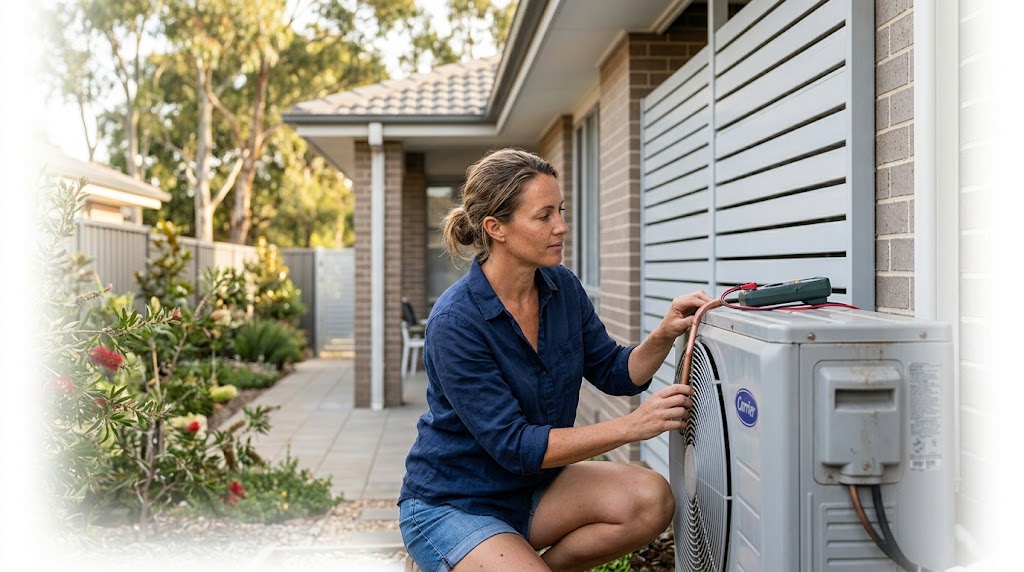
Why Is Your Air Conditioner Not Cooling?
There are few things more frustrating than switching on your air conditioner during an Australian summer heatwave, hearing it hum away and realising the room is still sweltering. If your air conditioner is not cooling properly, you are not alone. It is one of the most common calls technicians receive every summer, and the cause is often something straightforward.
Most cases come down to one of six culprits: a dirty or blocked air filter, incorrect thermostat or mode settings, frozen evaporator coils, low refrigerant from a leak, a dirty or obstructed outdoor condenser unit, or a unit that is simply too small for the space. This article walks through each one so you can diagnose the problem and decide whether it is a quick DIY fix or time to call a professional.
Key takeaways
- A dirty air filter is the most common reason your air conditioner is not cooling properly.
- Check thermostat settings, outdoor unit blockages and frozen coils before calling a technician.
- Refrigerant leaks and electrical faults require a licensed professional to repair.
The Most Common Reasons an AC Stops Cooling
An air conditioner that runs but fails to cool the room is almost always caused by one of the following six issues. Understanding what each problem looks like will help you pinpoint the fault before spending money on a service call.
Dirty or Blocked Air Filter
The air filter sits in front of the evaporator coil and catches dust, pet hair and airborne particles before they can coat the coil's surface. When the filter becomes clogged, airflow across the coil drops sharply, and the unit loses its ability to absorb heat from the room. In severe cases, the restricted airflow causes the unit to overheat and shut itself down on thermal overload protection.
You will typically notice weaker airflow from the vents, the room taking much longer to cool, or the unit cycling off before reaching the set temperature. Most manufacturers recommend cleaning or replacing filters every four to six weeks during periods of heavy use. It takes about five minutes and costs nothing if you have a washable filter.
Incorrect Thermostat or Mode Settings
Before assuming a mechanical fault, check the remote. The unit may be set to 'Fan Only' mode, which circulates air without activating the compressor or refrigerant cycle, so no actual cooling occurs. Alternatively, the set temperature may be higher than the current room temperature, meaning the unit has already reached its target and is simply idling.
Dead or weak remote batteries can also cause erratic behaviour, including the unit ignoring commands or defaulting to a previous mode. This is always the first thing to check because it costs nothing to fix and takes under a minute.
Frozen Evaporator Coils
The evaporator coil needs a steady flow of warm room air passing over it to function correctly. If airflow is restricted by a dirty filter, or if refrigerant levels are low, the coil's surface temperature can drop below zero and ice will begin to form on it. Once the coil is iced over, heat exchange stops almost entirely and the unit blows air that is barely cooler than the room.
Signs include visible ice on the indoor unit, water dripping or pooling around the unit as the ice melts, and noticeably reduced airflow. If you suspect frozen coils, switch the unit to 'Fan Only' mode and leave it running for two to three hours to thaw the coil before investigating the underlying cause.
Low Refrigerant or a Refrigerant Leak
Refrigerant is not a consumable. Under normal operation, the refrigerant level in a sealed system stays constant for the life of the unit. If levels are low, there is a leak somewhere in the system. Common symptoms include a hissing or bubbling sound near the indoor or outdoor unit, ice forming on the outdoor unit's copper lines, and the system blowing air that feels cool but never gets properly cold.
Refrigerant handling is licensed work in Australia under the Australian Refrigeration Council (ARC) framework. It is illegal for unlicensed individuals to purchase or handle refrigerants, so this is not a DIY repair. A qualified technician will locate the leak, repair it and recharge the system to the correct level.
Dirty or Blocked Outdoor Condenser Unit
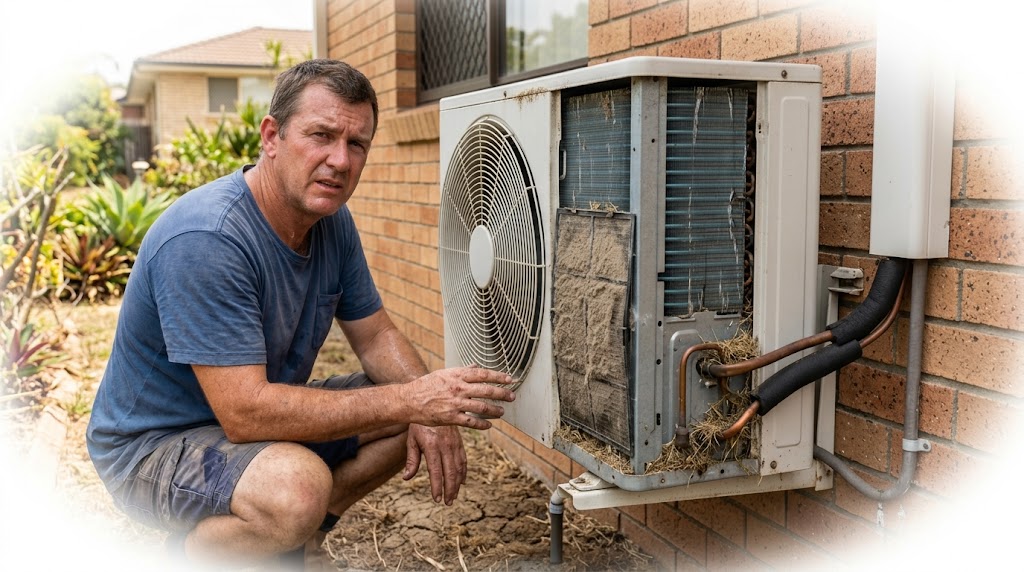
The outdoor unit's job is to expel the heat extracted from your room into the outside air. It does this by pushing air through the condenser coils. If those coils are caked in dirt, grass clippings, leaves or cottonwood fluff, the unit cannot shed heat efficiently and cooling performance drops noticeably, even if the indoor unit appears to be working fine.
Restricted clearance around the outdoor unit causes the same problem. As a general rule, keep at least 500mm of clear space on all sides of the outdoor unit and make sure nothing is stacked against it. A gentle rinse with a garden hose, with the unit switched off at the isolator, can clear light surface debris from the coils.
Undersized Unit for the Space
An air conditioner that is too small for the room will run continuously at full capacity without ever reaching the set temperature. The compressor never gets a rest, energy bills climb and the room stays uncomfortably warm. As a rough guide, a 2.5kW unit suits rooms up to around 20 square metres, while a 5kW unit is better suited to spaces of 40 to 50 square metres.
Those figures are starting points only. Ceiling height above 2.4 metres, poor insulation, large north or west-facing windows and open-plan layouts all increase the cooling load and push you toward a larger capacity. If your unit is the right size on paper but still struggles, check the other causes on this list before assuming you need an upgrade.
How to Fix an Air Conditioner That Is Not Cooling: Step-by-Step
Most air conditioner cooling problems can be narrowed down and resolved by working through a logical sequence of checks, starting with the simplest and cheapest possibilities first. Steps 1 through 6 below are safe for any homeowner to carry out. Step 7 involves refrigerant and electrical diagnostics, which must be handled by a licensed professional.
- Check and correct the mode and temperature settings on the remote. Confirm the unit is set to 'Cool' mode, not 'Fan Only' or 'Dry'. Then check that the set temperature is at least two to three degrees below the current room temperature. If the room has already reached the target, the compressor will idle and no cooling will occur. Replace the remote batteries while you are at it.
- Inspect and clean the indoor air filter. Remove the front panel of the indoor unit and pull out the filter. Hold it up to the light. If you cannot see through it, it needs cleaning. Rinse a washable filter under lukewarm water, let it dry completely and reinstall it. A blocked filter is the single most common cause of poor cooling performance.
- Check the outdoor unit for blockages and clear any debris. Walk outside and look at the condenser unit. Remove any leaves, grass clippings, cottonwood fluff or other debris from the grille and surrounding area. Make sure there is at least 500mm of clear space on all sides. With the unit switched off at the isolator, a gentle rinse with a garden hose can clear light dirt from the coil fins.
- Turn the unit off and allow frozen coils to thaw. If you noticed ice on the indoor unit or reduced airflow, switch the system to 'Fan Only' mode and run it for two to three hours. This melts any ice on the evaporator coil without forcing the compressor to work. Once thawed, switch back to 'Cool' mode and monitor performance. If the coil freezes again, the underlying cause is either a dirty filter (check step 2) or low refrigerant (step 7).
- Check the circuit breaker and power supply. Head to your switchboard and check that the breaker for the air conditioner has not tripped. A tripped breaker will often sit in a middle position rather than fully off. Reset it once. If it trips again immediately, do not reset it a second time. A repeatedly tripping breaker points to an electrical fault that needs a licensed electrician.
- Apply the 3-minute rule before restarting. After any shutdown, wait at least three minutes before switching the unit back on. This allows the compressor pressure to equalise. Restarting too quickly can cause the compressor to struggle against high head pressure, which may trigger the unit's protection circuit and prevent it from cooling. See the FAQ section below for more detail on this.
- If none of the above resolves the issue, call a licensed refrigeration technician. At this point the fault is most likely a refrigerant leak, a failing compressor or an electrical component issue. All three require a professional with an Australian Refrigeration Council (ARC) licence. Attempting to handle refrigerant without a licence is illegal in Australia and can void your warranty.
If your unit is older and the technician's quote for repairs is starting to look steep, it may be worth considering a replacement rather than pouring money into ageing equipment. Browsing split system air conditioners is a good starting point to compare what a modern replacement would cost.
When to Call a Professional vs. Replace Your Unit
If your air conditioner is not cooling and the DIY checks have not resolved it, the decision comes down to whether you repair the existing unit or replace it. The right answer depends on the age of the unit, the type of fault and the cost of the repair relative to the cost of a new system.
Repair Is Usually Worth It If...
The unit is under five years old and the fault is a refrigerant leak or a compressor issue. At that age, the system still has most of its working life ahead of it and a quality repair will restore full performance. Most manufacturers offer a five-year warranty on parts, so check your documentation before paying for anything out of pocket. A refrigerant recharge and leak repair on a relatively new system typically costs between $200 and $500, which is well below the cost of replacement.
Replacement Makes More Sense If...
The unit is 10 or more years old, the repair quote exceeds half the price of a comparable new unit, or the system runs on R22 refrigerant. R22 has been phased out in Australia and is no longer legally available for purchase, which means any system still running on it cannot be recharged if it develops a leak. At that point, replacement is the only practical path forward.
There is also a strong energy efficiency argument for replacing an older unit. Inverter split systems sold today are significantly more efficient than units from a decade ago. A modern system with a high star rating can cut your cooling running costs by 30 to 50 per cent compared to an older fixed-speed unit, which goes a long way toward offsetting the upfront purchase price over a few summers.
What a Replacement Costs
Entry-level options are more accessible than many people expect. The Daikin 2.5kW Inverter Split System LITE (FTXF25WVMA) is priced at $989 and suits bedrooms and smaller living areas up to around 20 square metres. For larger rooms of 40 to 50 square metres, the Daikin 5kW Inverter Split System CORA (FTXV50WVMA) is a well-rounded mid-range choice at $1,697, with a higher energy star rating and a quieter indoor unit. If you have an open-plan living area or a larger space, the Daikin 7.1kW Inverter Split System LITE (FTXF71WVMA) steps up to $1,977 and handles the extra load without breaking the bank.
All three are inverter models, meaning they modulate compressor speed rather than cycling on and off at full power, which keeps running costs lower over time. Browse the full range of Daikin split systems to compare capacities and features, or check out split system air conditioners on sale if you are working to a tighter budget.
Keep Your Air Conditioner Cooling All Summer Long
Most air conditioner cooling failures come down to a handful of well-known causes, and a methodical check will identify the culprit in the majority of cases without spending a cent on a technician. Regular filter cleaning remains the single most effective thing you can do to prevent problems before they start. Knowing when a fault has moved beyond DIY territory saves you from throwing money at a unit that needs professional attention or outright replacement.
If your current unit is beyond economical repair or simply too small for the space it is trying to cool, a modern inverter split system will outperform it on every measure. Browse our full range of split system air conditioners to find the right capacity and brand for your home.
Frequently Asked Questions
Why is my AC running but not cooling down?
The most common reasons your AC is running but not cooling are a dirty air filter, incorrect mode settings or low refrigerant. Other possibilities include frozen evaporator coils, a blocked or dirty condenser unit outdoors, or a system that is simply undersized for the space. Work through the step-by-step checks in this article before calling a technician, as most of these issues can be identified and resolved without a service call.
How to fix an aircon that is not cooling?
To fix an aircon that is not cooling, start by checking that the unit is set to 'cool' mode with the temperature set below the current room temperature, then clean or replace the air filter. Next, inspect the outdoor unit for blockages such as leaves or debris, and if you notice ice on the unit, switch it off and allow it to thaw completely before restarting. Refrigerant leaks and electrical faults are not DIY repairs and must be handled by a licensed technician.
How do I reset my central AC not blowing cold air?
You can reset most split systems and ducted units by switching the unit off at the wall isolator switch, waiting at least three minutes, then powering it back on. Some indoor head units also have a dedicated reset button, and many systems can be reset via the remote control by holding the reset function. If the fault code or lack of cooling persists after a reset, the system needs a professional service call to diagnose the underlying issue.
What is the 3 minute rule for air conditioners?
The 3-minute rule means waiting at least three minutes after switching an air conditioner off before turning it back on. This pause allows the refrigerant pressure inside the system to equalise, protecting the compressor from starting under high pressure load, which can cause mechanical damage or trigger a fault lockout. Always follow this rule after a power outage, a manual shutdown or a reset to avoid unnecessary wear on the compressor.
Need expert advice?
Our team can help you choose the right air conditioning system for your space.