
What Is Aircon Regassing and How Much Does It Cost in Australia?
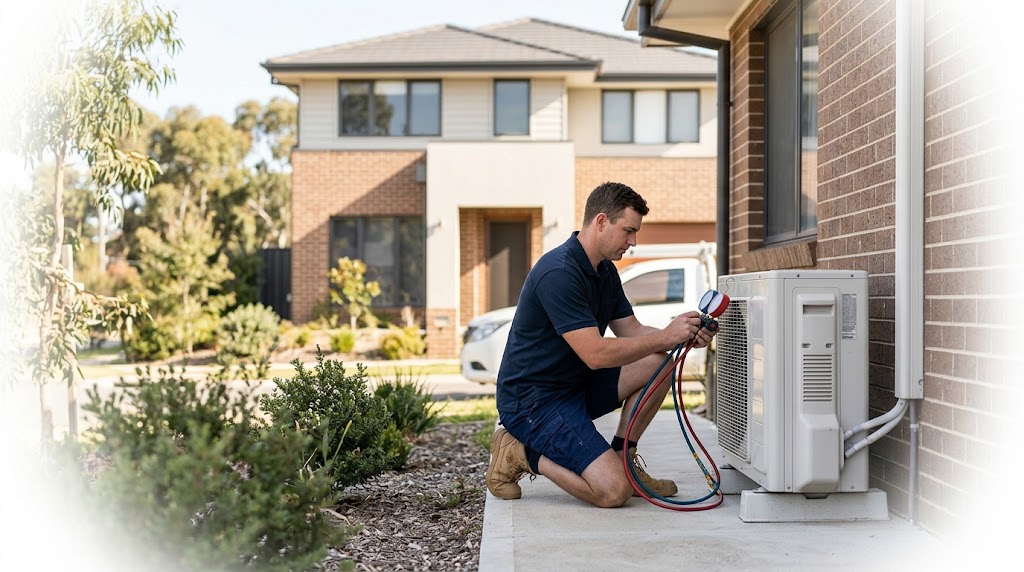
What Does Getting Your Aircon Regassed Actually Mean?
Getting your aircon regassed means having a licensed technician refill or top up the refrigerant inside your air conditioning system. Refrigerant is the substance that does the actual work of absorbing heat from your indoor air and transferring it outside, so when levels drop, your system loses its ability to cool or heat effectively. If your aircon has been blowing warm air, struggling to reach the set temperature or running longer than usual, low refrigerant is a likely culprit.
Here is the key thing most people do not realise: home air conditioners are sealed systems. Unlike a car aircon, they are not designed to consume refrigerant over time. So if your system needs a regas, that refrigerant has gone somewhere. Almost always, that means there is a leak or a fault somewhere in the system, and simply topping up the gas without finding and fixing the source is a short-term fix at best.
Key takeaways
- Aircon regassed means refilling refrigerant, which should only happen if a leak is found and fixed
- Sealed systems should never need regassing under normal circumstances
- Low refrigerant causes warm airflow, ice buildup and constant running without cooling
How Does Refrigerant Work in a Split System?
Refrigerant circulates continuously through your split system in a closed loop, changing between liquid and gas states to move heat from one place to another. Understanding this cycle helps explain why even a small drop in refrigerant levels can have a big impact on performance.
The process starts at the indoor unit. Warm air from your room passes over the evaporator coil, which contains cold, low-pressure refrigerant. The refrigerant absorbs that heat and evaporates into a gas. It then travels through copper piping to the outdoor unit, where the compressor pressurises it and the condenser coil releases the absorbed heat into the outside air. The refrigerant cools back into a liquid and the cycle repeats. In heating mode, the process simply runs in reverse.
When refrigerant levels are low, the evaporator coil cannot absorb enough heat. You may notice ice forming on the indoor unit, reduced airflow or a system that runs constantly without cooling the room down. These are all signs the refrigerant charge is off and the system needs attention from a licensed technician.
R32 vs R410A vs R22: Which Refrigerant Does Your System Use?
Most split system air conditioners sold in Australia today use R32 refrigerant, which has been the industry standard for new systems since around 2018. Older systems installed before that era typically run on R410A, while anything more than 15 to 20 years old may still use R22, also known as Freon. Knowing which refrigerant your system uses matters because it directly affects what a regas will cost and whether a regas is even legally possible.
R22 was phased out in Australia under the Montreal Protocol due to its ozone-depleting properties. It is no longer legally available for top-ups, which means any system still running on R22 cannot be regassed. If your old R22 unit develops a refrigerant leak, replacement is the only real option.
| Refrigerant Type | Common In | Environmental Impact (GWP) | Regas Cost Indicator | Notes |
|---|---|---|---|---|
| R22 (Freon) | Systems installed before ~2010 | Very high (1,810 GWP) | Not available | Banned for top-ups in Australia. Replacement is the only option if the system leaks. |
| R410A | Systems installed ~2010 to 2018 | High (2,088 GWP) | Moderate to high | Still serviceable but being phased down. Regas is possible but costs more than R32. |
| R32 | Systems installed from ~2018 onwards | Lower (675 GWP) | Most affordable | Current industry standard. Widely available, easier to handle and lower environmental impact. |
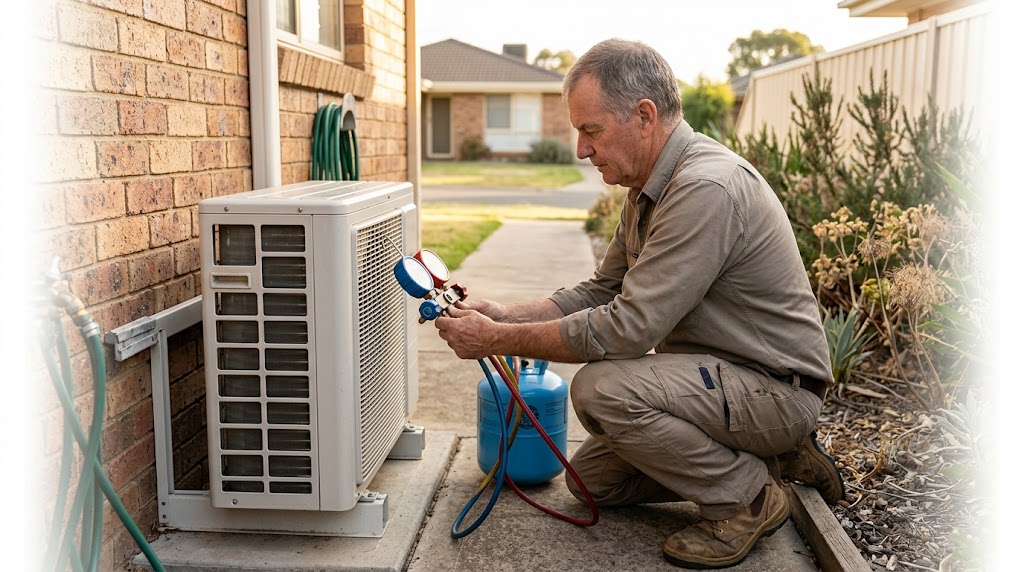
Signs Your Aircon Needs to Be Regassed
The most common signs of low refrigerant in a split system are warm airflow on the coldest setting, ice forming on the indoor unit and a system that runs non-stop without cooling the room down. These symptoms point to a refrigerant issue, but they can also be caused by other faults, so a licensed technician should always diagnose the problem before any regas is carried out.
- Warm or weak airflow on the coldest setting. If your system is set to 18°C but the air coming out feels barely cool, the refrigerant charge is likely too low to absorb heat effectively from your indoor air.
- The system runs continuously but never reaches the set temperature. A properly charged system should cycle off once the room hits the target temperature. Constant running without reaching that point is a classic sign something is off with the refrigerant level.
- Ice forming on the indoor unit or refrigerant lines. This sounds counterintuitive, but low refrigerant causes the evaporator coil to get too cold and freeze over. You may notice frost or ice on the copper pipes or the indoor unit itself.
- A hissing or bubbling sound near the indoor or outdoor unit. These noises can indicate refrigerant escaping through a crack or loose fitting in the system. A hiss usually points to a gas leak, while bubbling can suggest moisture has entered the refrigerant circuit.
- Unusually high electricity bills despite normal usage. A system struggling with low refrigerant has to work much harder and run much longer to achieve the same result, which shows up on your power bill.
- The outdoor unit's compressor cycling on and off more than usual. Short cycling, where the compressor starts and stops repeatedly in quick succession, puts extra strain on the unit and often points to a refrigerant or pressure issue.
None of these symptoms are definitive proof that a regas is needed. A dirty filter, a blocked drain, a faulty thermostat or a failing compressor can produce very similar results. Always get a proper diagnosis from a licensed refrigeration mechanic before spending money on refrigerant.
How Much Does It Cost to Get Your Aircon Regassed in Australia?
For a standard residential split system in Australia, a basic regas using R32 or R410A refrigerant typically costs between $200 and $350 for refrigerant and labour. If a leak needs to be found and repaired first, expect to pay $400 to $700 in total. Older R22 systems cannot legally be regassed at all, so replacement is the only path forward for those units.
The table below gives a clear breakdown of what to expect depending on your system type and the scope of work involved.
| Service Type | Refrigerant Type | Typical Cost Range (AUD) | Notes |
|---|---|---|---|
| Basic regas (refrigerant + labour, no leak repair) | R32 or R410A | $200 to $350 | Suitable only if the cause of refrigerant loss has already been identified and fixed. |
| Full-service regas (leak detection + repair + regas) | R32 or R410A | $400 to $700 | The more realistic cost for most jobs. Leak detection adds time and labour to the bill. |
| Regas on older system | R410A (ageing unit) | $350 to $600+ | R410A costs more per kilogram than R32. Older systems may need more refrigerant and are more likely to have multiple leak points. |
| R22 system regas | R22 (Freon) | Not available | R22 top-ups are banned in Australia. Replacement is the only legal option. |
Several factors push the final price up or down. The main ones are:
- Refrigerant type. R32 is the cheapest and most widely available. R410A costs more per kilogram. R22 cannot be purchased at all.
- System size (kW). A larger system holds more refrigerant, so a full recharge on a 7kW or 8kW unit will cost more than on a 2.5kW model.
- Accessibility. Units installed in tight roof spaces, high on walls or in hard-to-reach locations take longer to service, which adds to the labour cost.
- Leak repair. Finding and fixing a leak is often the most time-consuming part of the job. A simple fitting tightening is cheap. A cracked coil or damaged line set is not.
- Call-out fee. Most technicians charge a call-out fee of $80 to $150 before any work begins. This is separate from the labour rate and applies even if the job turns out to be straightforward.
When Is It Cheaper to Replace Than Regas?
If your system is over 10 years old, uses R410A refrigerant and has a leak that needs repairing, the total bill can easily reach $600 to $700 or more. At that point, replacing the unit is often the smarter financial decision, not just a short-term fix on a system that is already past its best years.
The maths becomes even clearer if the system is older still or has had multiple repairs. A new Daikin 2.5kW Lite FTXF25WVMA retails for $989, and the 3.5kW Daikin Lite FTXF35WVMA comes in at $1,194. For a larger room, the Daikin 5kW Lite FTXF50WVMA is $1,589. These are entry-level units, but they come with a manufacturer warranty, use modern R32 refrigerant and will run far more efficiently than an ageing system that has already needed one expensive repair.
A rough rule of thumb: if the repair bill exceeds roughly half the cost of a comparable new unit, replacement is worth serious consideration. New systems also benefit from current energy efficiency ratings, which can reduce your running costs over time compared to an older, less efficient model.
If replacement makes more sense for your situation, browse our range of split systems to compare current prices and find the right size for your space.
Can You Regas an Aircon Yourself? What Australian Law Says
No, you cannot legally regas an aircon yourself in Australia. Under the Ozone Protection and Synthetic Greenhouse Gas Management Act, only technicians holding an ARCtick licence issued by the Australian Refrigeration Council are permitted to purchase, handle, recover or dispose of refrigerants. This applies to the full scope of refrigerant work, not just the regas itself.
The restriction exists for good reason. Refrigerants like R32 and R410A are synthetic greenhouse gases with significant global warming potential. Improper handling can release them directly into the atmosphere, which is both an environmental offence and a legal one. Fines for unlicensed refrigerant handling can reach tens of thousands of dollars for individuals, and higher still for businesses.
Beyond the legal risk, attempting a DIY regas almost always causes more problems than it solves. Without the right equipment, you cannot accurately measure the refrigerant charge, which means you risk overcharging the system and damaging the compressor. Most manufacturers, including Daikin, specify in their warranty terms that refrigerant work must be carried out by a licensed technician. Any DIY attempt will void that warranty immediately.
Before booking any technician, ask for their ARCtick licence number. A legitimate professional will have no hesitation providing it, and you can verify it through the Australian Refrigeration Council's online register. This one step protects you from unlicensed operators and ensures the work is done correctly.
How to Prevent Refrigerant Leaks and Avoid Costly Regassing
A well-installed, well-maintained split system should rarely if ever need regassing. Refrigerant leaks are almost always the result of poor installation, physical damage or years of neglect, which means most can be prevented with a few straightforward habits.
The single most effective thing you can do is book an annual service with a licensed technician. A professional service includes a check of refrigerant pressure, inspection of the copper line set and fittings, and a look at the coils for any signs of corrosion or damage. Catching a small leak early costs far less than dealing with a full regas and repair job later.
Beyond annual servicing, these steps will help keep your system in good shape:
- Keep the outdoor unit clear. Vegetation, debris and dirt build-up around the outdoor unit restrict airflow and can cause the system to run hotter than it should. Leave at least 30cm of clear space around the unit and trim back any plants that are encroaching on it.
- Never attempt DIY repairs to refrigerant lines or fittings. Even tightening a fitting incorrectly can introduce a slow leak. Any work on the refrigerant circuit must be done by a licensed technician.
- Make sure the original installation was done properly. Poor installation is one of the leading causes of refrigerant leaks. Flared fittings that were not made correctly, line sets that were bent too sharply or connections that were not pressure-tested will eventually fail. Always use a licensed installer from the start.
- Act on early warning signs. Reduced cooling performance, ice on the indoor unit or unusual sounds are all worth investigating promptly. Ignoring them gives a small problem time to become a large one.
Brands such as Daikin specify in their warranty terms that refrigerant work must be carried out by a licensed technician. See our Daikin split systems range for current models and warranty details. A quality system installed correctly and serviced annually is your best defence against unexpected repair bills.
Frequently Asked Questions About Getting Your Aircon Regassed
How long does an aircon regas take?
A basic regas on a residential split system typically takes one to two hours. If the technician needs to locate and repair a leak first, the job can take two to four hours depending on where the leak is and how accessible the system is. Always factor in the call-out time when booking.
How often does an aircon need to be regassed?
A properly installed and maintained split system should never need regassing under normal circumstances. Refrigerant does not get used up over time. If your system needs a regas, it means refrigerant has escaped through a leak, and that underlying fault needs to be found and fixed, not just topped up repeatedly.
Can a regas fix my aircon if it is not cooling?
A regas will only fix a cooling problem if low refrigerant is the confirmed cause. Warm airflow can also result from a dirty filter, a blocked drain, a faulty thermostat or a failing compressor. A licensed technician should diagnose the system before any refrigerant work is carried out.
Is aircon regassing covered by warranty?
Most manufacturer warranties cover refrigerant leaks caused by defects in materials or workmanship, but not leaks caused by poor installation or physical damage. Check your warranty documentation carefully. Any refrigerant work must be carried out by a licensed ARCtick technician, or the warranty may be voided regardless of the cause.
What happens if you do not regas a leaking aircon?
Running a system with low refrigerant puts serious strain on the compressor, which is the most expensive component in the unit. Over time, the compressor can overheat and fail entirely. A regas that might have cost $300 to $500 can turn into a compressor replacement costing $1,000 or more, or a full system replacement.
Is Your Aircon Struggling? It Might Be Time for a New System
Regassing is sometimes the right fix, but it is never the whole story. If your system needs a regas, there is always an underlying reason, whether that is a slow leak, a damaged fitting or years of wear. Costs typically range from $200 to $350 for a straightforward regas up to $700 or more when leak detection and repair are involved.
If your system is over 10 years old, runs on R22 or has already had multiple repairs, replacement is often the more sensible investment. A new system comes with a manufacturer warranty, uses modern R32 refrigerant and will run more efficiently than an ageing unit that keeps needing attention. The Daikin 3.5kW Lite FTXF35WVMA at $1,194 is a good example of what a competitively priced new system looks like compared to a costly repair bill on an old one.
Whatever path you take, make sure any refrigerant work is handled by a licensed ARCtick technician. It is a legal requirement in Australia, and it protects both your system and your warranty. If a new system makes more financial sense, view our full range of split system air conditioners and compare prices from all the major brands.
Need expert advice?
Our team can help you choose the right air conditioning system for your space.