
Does Your Split System Actually Bring in Fresh Air? Aircon Ventilation Explained

The Truth About Aircon Ventilation and Split Systems
Aircon ventilation is one of the most misunderstood topics in home comfort. Many Australians assume their split system is quietly pulling in a stream of fresh outdoor air while it runs, but that is not how these units work. A standard split system recirculates the air already inside your room. It cools it, heats it or filters it, then pushes it back out into the same space. No fresh air enters the living area through the unit itself.
This article explains exactly how the refrigeration cycle works, what 'ventilation' actually means in an HVAC context, and the practical steps you can take to improve fresh air flow in a home that relies on a split system for climate control. By the end, you will know what your unit can and cannot do, and how to fill the gaps.
Key takeaways
- Split systems recirculate indoor air and do not introduce fresh outdoor air, so aircon ventilation requires separate solutions.
- Ventilation, mechanical fans and air conditioning are three distinct functions that serve different purposes.
- Simple habits like opening windows daily and running exhaust fans work alongside your split system to improve air quality.
How a Split System Actually Works
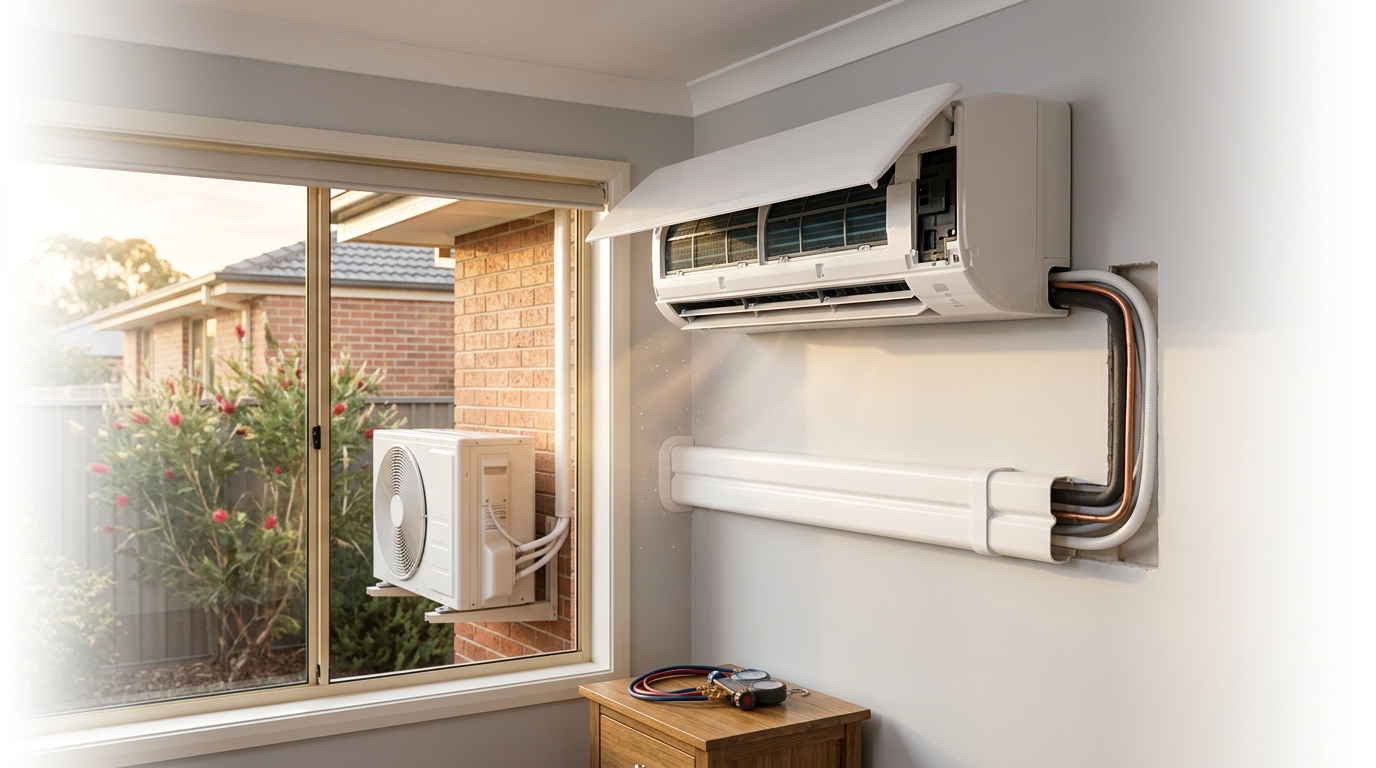
A split system air conditioner consists of two units connected by refrigerant lines: an indoor wall-mounted unit and an outdoor compressor unit. The indoor unit draws air from the room through a return air grille, passes it over an evaporator coil filled with refrigerant, and then blows the conditioned air back into the same room. The outdoor unit releases or absorbs heat depending on whether you are cooling or heating. At no point does outdoor air travel through this process into your living space.
The refrigerant lines and electrical cables connecting the two units pass through a small hole drilled in the wall, typically 65 to 75mm in diameter. This penetration is sealed with putty or foam on both sides during installation. It is a sealed conduit for pipes and cables, not an air pathway. Even on a windy day, no meaningful airflow passes through that opening into your home.
This design is intentional. By working with a closed loop of indoor air, the system can reach your target temperature much faster and maintain it more efficiently than if it were constantly conditioning fresh outdoor air. The trade-off is that the air quality inside your home depends entirely on what is already in the room, plus whatever you introduce through windows, doors or a dedicated ventilation system.
What the Indoor Unit's Filter Actually Does
The built-in filter on a split system's indoor unit sits behind the front panel and captures dust, pet hair, pollen and larger airborne particles as air passes through on its way to the evaporator coil. This does improve the cleanliness of the air circulating in your room, but it is working with the same indoor air on every pass. The filter has no connection to the outdoors and cannot introduce fresh air into the space.
Most standard filters are washable mesh screens designed to protect the coil from dust build-up rather than to provide hospital-grade air purification. Some premium models go further. The Mitsubishi Electric AP Series, for example, includes a plasma quad filter that targets finer particles and some allergens. Daikin's higher-end units offer activated carbon layers that can reduce odours. These are genuine improvements to indoor air quality, but they are still operating on recirculated indoor air. If the air in your room contains elevated CO2 from occupants or volatile organic compounds from furniture and cleaning products, a better filter will not remove those. Only fresh air exchange will.
If you are browsing split system air conditioners and air quality is a priority for your household, it is worth comparing the filtration specifications across models, but keep in mind that filtration and ventilation are two separate problems that require separate solutions.
What Aircon Ventilation Actually Means
Ventilation, in the proper building sense, is the deliberate introduction of outdoor air into an indoor space to dilute CO2, moisture, odours and airborne pollutants. It is a separate function from air conditioning entirely. There are three distinct types: natural ventilation (opening windows and doors), mechanical ventilation (exhaust fans, heat recovery ventilators and similar devices) and air conditioning (temperature control of recirculated indoor air). Understanding the difference matters because only the first two actually replace the air in your home.
Australia's National Construction Code sets minimum ventilation requirements for habitable rooms, typically requiring either openable windows of a certain size or a mechanical alternative. These requirements exist because fresh air exchange is treated as a health and safety baseline, not a comfort bonus. A split system, no matter how advanced, does not satisfy these requirements on its own because it does not introduce outdoor air into the space.
The three types of ventilation serve different purposes and are often confused with one another. The table below summarises how they differ:
| Type | How it works | Introduces fresh air? | Controls temperature? |
|---|---|---|---|
| Natural ventilation | Open windows and doors allow outdoor air to flow through | Yes | No |
| Mechanical ventilation | Ventilation fans, exhaust fans and heat recovery ventilators move air in or out mechanically | Yes | No (unless heat recovery) |
| Air conditioning | Recirculates and conditions existing indoor air via a refrigerant cycle | No | Yes |
Why Sealed Modern Homes Need More Than Just Aircon
Newer Australian homes are built to much tighter energy efficiency standards than homes from even 20 years ago. Better insulation, double-glazed windows and draught sealing all reduce the natural air infiltration that older homes relied on to passively refresh indoor air. This is great for your energy bills, but it creates a real indoor air quality challenge.
In a well-sealed home, CO2 from occupants can climb noticeably over the course of a day, particularly in bedrooms overnight or in living areas with multiple people. Humidity from cooking, showers and breathing also accumulates without adequate air exchange. A split system running continuously will keep the temperature comfortable, but it cannot address these build-ups because it is working with the same parcel of indoor air on every cycle. Supplementary ventilation strategies, whether as simple as opening windows at cooler times of day or as involved as installing a mechanical ventilation unit, become genuinely important in these homes rather than optional extras.
How to Improve Fresh Air Flow Alongside Your Split System
Improving aircon ventilation in a home with a split system does not require replacing your unit or undertaking major renovations. A combination of simple habits and targeted products can make a meaningful difference to the freshness and quality of the air in your home. The following steps are ordered from the simplest and cheapest through to more involved solutions for tightly sealed homes.
- Open windows and doors for 10 to 15 minutes in the morning and evening. This is the single most effective and lowest-cost step. Flushing the house with outdoor air twice a day clears accumulated CO2, moisture and odours. Do this before you turn the split system on for the day, so you are not conditioning air you are about to replace.
- Use exhaust fans in bathrooms and kitchens every time you cook or shower. These rooms generate the most moisture and odour in a typical home. Running the exhaust fan during and for 10 minutes after each event removes that air before it spreads through the rest of the house and recirculates through your split system.
- Consider a dedicated mechanical ventilation unit for tightly sealed homes. A heat recovery ventilator (HRV) or energy recovery ventilator (ERV) brings in fresh outdoor air while transferring heat from the outgoing air, so you are not losing all your heating or cooling in the process. These are a more significant investment but are increasingly common in new builds and renovations.
- Clean your split system's filters every four to six weeks during heavy use. A clogged filter restricts airflow and reduces the unit's ability to circulate and condition the air it does have access to. Most manufacturers recommend rinsing the washable mesh filter under warm water and allowing it to dry fully before reinserting. This will not introduce fresh air, but it keeps the recirculated air as clean as possible.
- Look at models with advanced filtration or ionisation features if indoor air quality is a priority. If you are choosing a new unit, filtration quality is worth comparing. The Daikin 2.5kW Inverter Split System Lite FTXF25WVMA ($989) is an accessible entry-level option with a washable filter that is easy to maintain. Step up to the Mitsubishi Electric 2.5kW AP Series MSZAP25VGKD ($1,122) and you get a plasma quad filter that captures finer particles and some allergens. For a broader look at what is available, Daikin split systems offer a range of filtration tiers across their lineup.
For homes where opening windows is not always practical, whether due to noise, security or outdoor air quality on high-pollution days, a supplementary exhaust fan is a practical middle ground. The Blauberg Turbo Mixed Flow Ventilation Exhaust Fan (150mm, from $298) is a compact, low-noise option that can be installed in a wall or ceiling to provide consistent mechanical air extraction without the complexity of a full HRV system. It is a straightforward upgrade that works alongside your existing split system rather than replacing any part of it.
Choosing a Split System With Better Built-In Air Quality Features
If you are buying a new split system and air quality is a priority, some models offer meaningfully better filtration than others. These units still recirculate indoor air rather than introducing fresh air from outside, but a higher-quality filter does reduce the concentration of dust, pollen, pet dander and fine particles in the air that circulates through your home. Knowing which features are worth paying for helps you make a more informed choice.
At the entry level, the Daikin 2.5kW Inverter Split System Lite FTXF25WVMA ($989) is a solid starting point. It includes a washable mesh filter that is straightforward to remove, rinse and reinsert, which makes it easy to keep clean and performing well. For most households without specific allergy concerns, this level of filtration is perfectly adequate provided the filter is cleaned every four to six weeks during heavy use.
Step up to the Mitsubishi Electric 2.5kW Split System AP Series MSZAP25VGKD ($1,122) and you get a plasma quad filter alongside the standard washable screen. The plasma quad filter captures finer particles than a basic mesh filter, including some allergens and microscopic dust that would otherwise pass straight through. For households with allergy sufferers or pets, this is a worthwhile upgrade over the entry-level option. You can browse the full range of Mitsubishi Electric split systems to compare models and filtration tiers side by side.
At the premium end, the Mitsubishi Electric 5kW LN Series MSZLN50VGV ($2,720) adds advanced filtration alongside built-in WiFi and a higher-capacity output suited to larger rooms. The trade-off at this price point is that you are paying for a combination of performance, aesthetics and air treatment features rather than filtration alone.
For whole-home air quality, a ducted system paired with a fresh-air intake is the most comprehensive solution available. A ducted setup allows you to incorporate a higher-grade central filter and, critically, to connect a fresh-air duct that draws in and conditions outdoor air before distributing it through the home. No wall-mounted split system, regardless of its filtration spec, can replicate that level of whole-home air management.
| Model | Price | Filter type | Best for |
|---|---|---|---|
| Daikin FTXF25WVMA (2.5kW Lite) | $989 | Washable mesh | General households, easy maintenance |
| Mitsubishi Electric MSZAP25VGKD (2.5kW AP Series) | $1,122 | Plasma quad and washable | Allergy sufferers, pet owners |
| Mitsubishi Electric MSZLN50VGV (5kW LN Series) | $2,720 | Advanced multi-stage | Larger rooms, premium air treatment |
Frequently Asked Questions About Aircon Ventilation
Does a split system air conditioner bring in fresh air from outside?
No. A standard split system recirculates the air already inside your room. The outdoor unit only handles heat exchange via refrigerant lines and does not draw outdoor air into your living space. If you want fresh air, you need to open windows or use a dedicated mechanical ventilation system.
Does aircon help with ventilation?
Air conditioning and ventilation are two separate functions. An air conditioner conditions and filters recirculated indoor air but does not replace it with outdoor air. Ventilation, by definition, involves introducing fresh outdoor air into a space, which requires either open windows or a mechanical ventilation device such as an exhaust fan or heat recovery ventilator.
Can I run my split system with the windows open?
You can, but it significantly reduces efficiency. The unit will work much harder to maintain your target temperature because it is continuously conditioning warm or cold outdoor air entering through the windows. A better approach is to open windows for 10 to 15 minutes to flush the home with fresh air, then close them before turning the split system on.
Do split systems filter the air?
Yes, all split systems include at least a basic washable mesh filter that captures dust, pet hair and larger airborne particles. Some models go further with plasma filters or activated carbon layers that target finer particles and odours. These filters improve the quality of the recirculated indoor air but cannot remove CO2 or introduce fresh air from outside.
How do I get fresh air into a room with a split system?
The most practical options are opening windows and doors for short periods each day, running exhaust fans in bathrooms and kitchens, or installing a dedicated mechanical ventilation unit such as a heat recovery ventilator. For tightly sealed modern homes, a combination of regular window ventilation and a supplementary exhaust fan is usually sufficient for most households.
Does a split system remove CO2 from the air?
No. A split system filter captures particulate matter such as dust and pollen but cannot remove CO2, which is a gas. CO2 from occupants accumulates in sealed rooms over time and can only be reduced by introducing fresh outdoor air. If CO2 build-up is a concern, particularly in bedrooms overnight, regular ventilation or a mechanical fresh-air system is the appropriate solution.
Get the Right System for Your Home's Air Quality Needs
Split systems are excellent at heating and cooling your home efficiently, but they do not introduce fresh outdoor air on their own. They recirculate and filter the air already inside your space. For a genuinely healthy indoor environment, you need to pair your split system with regular ventilation habits or, in tightly sealed homes, a dedicated mechanical ventilation product.
The good news is that the two approaches work well together. A quality split system handles your comfort, while simple habits like flushing the house with fresh air each morning and running exhaust fans during cooking and showering handle the air exchange side. If you want to go further, supplementary products like the Blauberg Turbo Mixed Flow Ventilation Exhaust Fan (150mm, from $298) add consistent mechanical extraction without replacing anything you already have.
For the split system itself, options like the Daikin FTXF25WVMA ($989) and the Mitsubishi Electric MSZAP25VGKD ($1,122) show that better filtration is available at accessible price points. The right choice depends on your room size, household needs and how much you want to invest in air treatment features.
Browse the full split system air conditioners range to compare models, filtration specs and capacities, or get in touch with the team for personalised advice on the best setup for your home.
Need expert advice?
Our team can help you choose the right air conditioning system for your space.