
AirTouch Controller Review: Is It Worth It for Your Ducted Air Conditioner?

What Is the AirTouch Controller?
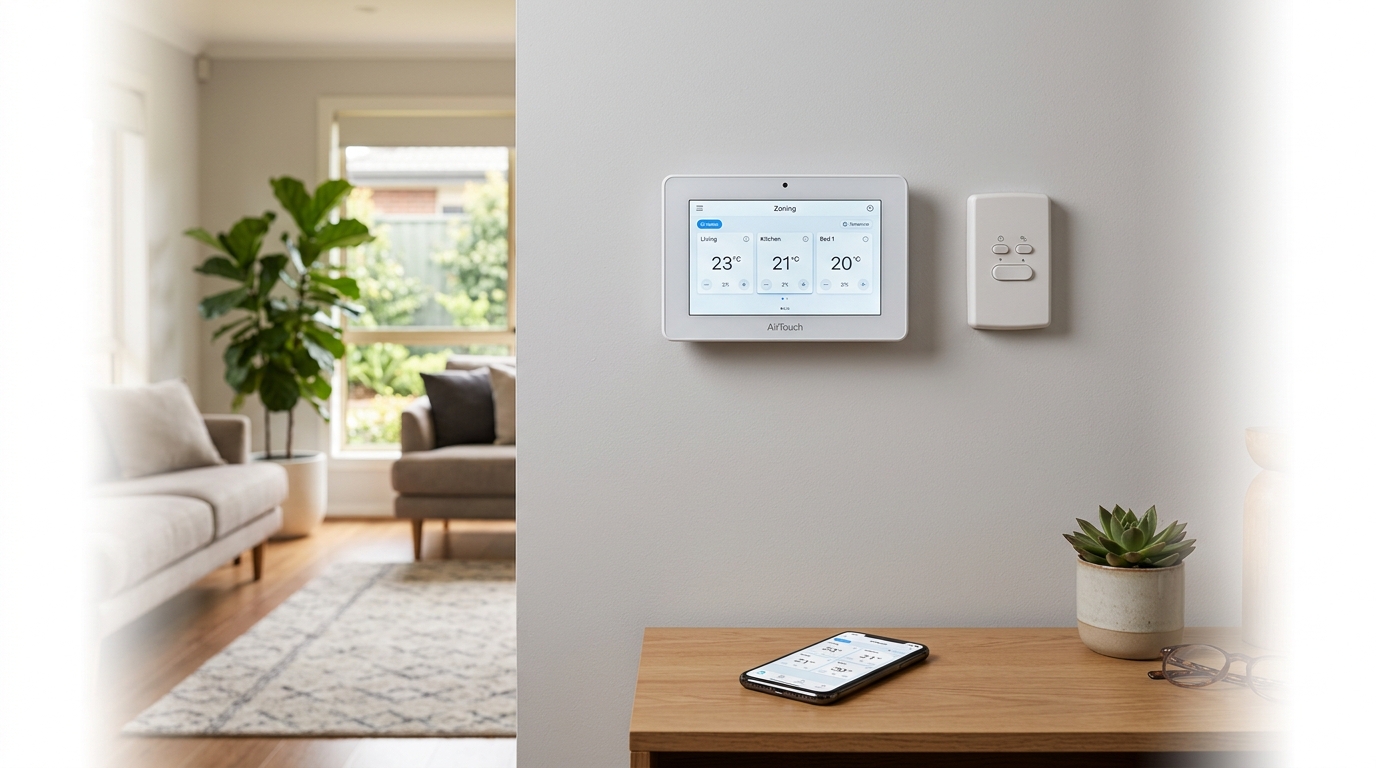
The AirTouch controller is a smart zoning and control system made by Australian company Polyaire, designed specifically for ducted air conditioners. Rather than relying on a basic wall-mounted thermostat, the AirTouch replaces or supplements your standard controller with a large touchscreen console, a full-featured smartphone app and zone-by-zone temperature management across your entire home.
The system sits between your ducted unit and your zone dampers, giving you precise control over which rooms are heated or cooled and at what temperature. For a standard ducted reverse cycle system, that level of control simply isn't available out of the box.
The central question this article addresses is whether the AirTouch upgrade cost is actually justified for Australian homeowners. A quality ducted system is already a significant investment, and adding a smart controller adds several hundred to several thousand dollars more. We'll break down exactly what you get, what it costs and where the real-world value lies.
Key takeaways
- The AirTouch controller is a smart zoning system that gives ducted air conditioners room-by-room temperature control via touchscreen and app
- The AirTouch 5 supports up to 16 zones and integrates with Google Home and Amazon Alexa for voice control
- Wireless temperature sensors add $120 per room but significantly improve energy-efficiency by providing real-time feedback
- Installation costs $300 to $600 on top of the $1,350 to $1,400 hardware price
AirTouch 5 Features: What You Actually Get
The AirTouch 5 is Polyaire's current flagship controller, and it packs a substantial feature set into a wall-mounted console and companion app. The headline hardware is an 8-inch HD touchscreen console that replaces your existing wall controller entirely. It's responsive, clearly laid out and designed to be used by anyone in the household without a manual. Beyond the console, the system supports control via iOS and Android apps, voice assistants and third-party smart home platforms.
Here's a summary of the core AirTouch 5 features at a glance:
| Feature | Detail |
|---|---|
| Console display | 8-inch HD touchscreen |
| Zone capacity | Up to 16 zones |
| AC units supported | Up to 2 independent ducted systems |
| Wireless temperature sensors | Optional, sold separately at approximately $120 each |
| App platforms | iOS and Android |
| Voice control | Google Assistant and Amazon Alexa |
| Smart home integration | Google Home and Amazon Alexa ecosystems |
| Geofencing | Auto off when you leave home |
| Energy monitoring | Built-in dashboard |
| Temperature alerts | Push notifications if home temp goes out of range |
The AirTouch 5 is compatible with most major ducted reverse cycle brands, including Daikin and Mitsubishi Electric. As a practical example, a Daikin 10kW Inverter Ducted Air Conditioner FDYAN100 (priced at $4,017) pairs directly with the AirTouch 5 using Daikin's native communication protocol, which allows the controller to read and adjust the unit's settings rather than just switching it on and off.
Zoning and Temperature Sensors
The AirTouch 5's zone control works by opening and closing motorised dampers in your ductwork to direct airflow only where it's needed. Without temperature sensors, the system relies on the central return air sensor to judge the home's overall temperature, which means individual rooms can still end up overcooled or overheated.
The wireless temperature sensors change that. Each sensor sits in a room and feeds real-time temperature data back to the controller, so the AirTouch can modulate airflow to that zone based on actual conditions rather than guesswork. For a four-bedroom home, you'd typically want four to six sensors covering the bedrooms, main living area and any problem rooms. At approximately $120 per sensor, that adds $480 to $720 to the overall cost.
The sensors are optional, and the system works without them. But if energy-efficiency is your main reason for upgrading, the sensors are where a significant portion of that efficiency gain actually comes from. Without them, you're still doing smarter zoning than a basic controller, but you're not getting the closed-loop temperature feedback that makes the system genuinely precise.
App Control and Smart Home Integration
The AirTouch app lets you control your ducted system from anywhere with an internet connection. You can turn zones on or off, adjust temperatures, set schedules and check the energy monitoring dashboard from your phone, whether you're in the next suburb or interstate. The geofencing feature uses your phone's location to automatically switch the system off when you leave a defined boundary around your home, and back on as you return.
For smart home users, the AirTouch 5 integrates with Google Home and Amazon Alexa, so you can control zones and temperatures by voice or include your air conditioner in broader home automation routines. If your internet drops out, the touchscreen console continues to work as a fully functional standalone wall controller, so you're never left without control of your system.
AirTouch Controller Compatibility: Which Ducted Systems Work With It?
The AirTouch 5 is compatible with most major ducted reverse cycle brands sold in Australia, including Daikin, Mitsubishi Electric, Fujitsu, Panasonic, Samsung and Actron Air. Compatibility is determined by the communication protocol used by your specific indoor unit, so the brand alone is not enough to confirm the AirTouch will work. A licensed installer must verify your exact model before you purchase.
The table below covers the major brands and general compatibility notes to give you a starting point:
| Brand | Compatible Models (General) | Notes |
|---|---|---|
| Daikin ducted systems | FDYAN, FDYQN, FDYAN-CV series and most current inverter ducted models | Uses Daikin's native serial communication for full integration. One of the most widely supported brands. |
| Mitsubishi Electric ducted systems | PEA-M series, PEAD series and most current inverter ducted models | Full integration via Mitsubishi Electric's M-NET protocol. Widely supported. |
| Fujitsu | ARTG series and most current inverter ducted models | Compatible via Fujitsu's UTY interface. Confirm model with installer. |
| Panasonic | S-series ducted inverter models | Compatible via Panasonic's CN-WIRED interface. Not all older models supported. |
| Samsung | DVM ducted series | Compatible via Samsung's MIM-B19 interface module. Additional hardware may be required. |
| Actron Air | ESP Plus and current ducted inverter range | Compatible with most current models. Actron Air is an Australian brand with strong AirTouch support. |
| LG | Ducted inverter models with PQNFB17B0 interface | Requires an additional interface module. Confirm compatibility before purchase. |
The AirTouch 5 suits both new ducted installations and retrofits onto existing systems. If you already have a ducted unit installed, an AirTouch retrofit is often straightforward provided your unit uses a supported communication protocol. For new builds, pairing the AirTouch 5 from the outset gives you the cleanest installation and the most complete integration.
As practical examples of compatible systems available from Air Conditioning Experts, the Daikin 10kW Inverter Ducted Air Conditioner FDYAN100 ($4,017) and the Mitsubishi Electric 10kW Inverter Ducted Air Conditioner PEA-M100HAA ($4,110) both work natively with the AirTouch 5 using their respective communication protocols, giving you full read and write control through the console and app.
AirTouch 2 vs AirTouch 5: Which Version Should You Choose?
The AirTouch 5 is Polyaire's current model and has largely replaced the AirTouch 2 across the market. Most installers now supply the AirTouch 5 as standard, and the AirTouch 2 is primarily encountered in older installations rather than new ones. If you're buying new, the AirTouch 5 is the version to specify.
Here's how the two versions compare across the features that matter most:
| Feature | AirTouch 2 | AirTouch 5 |
|---|---|---|
| Screen size | 7-inch touchscreen | 8-inch HD touchscreen |
| Max zones | Up to 8 zones | Up to 16 zones |
| Max AC units | 1 ducted system | Up to 2 independent ducted systems |
| Wireless sensors | Not supported | Supported (sold separately, approx. $120 each) |
| App control | iOS and Android (basic) | iOS and Android (full-featured) |
| Voice control | Not supported | Google Assistant and Amazon Alexa |
| Smart home integration | Limited | Google Home and Amazon Alexa ecosystems |
| Approximate price (supply only) | $700 to $900 | $1,100 to $1,400 |
The AirTouch 2's biggest limitations are its eight-zone ceiling and its lack of wireless temperature sensor support. For a smaller home with four to six zones and no smart home requirements, the AirTouch 2 can still do the job if you're inheriting one in an existing installation. But for a new build, a larger home or any property where you want room-by-room temperature feedback, the AirTouch 5 is the clear choice.
The price gap between the two versions is real but not dramatic. Given that the AirTouch 5 doubles the zone capacity, adds wireless sensor support and brings full voice and smart home integration, the extra outlay is straightforward to justify on a new installation. The AirTouch 2 is a legacy product at this point, and sourcing parts or support for it will only become harder over time.
Is the AirTouch Controller Worth the Cost?
The AirTouch 5 retails for approximately $1,350 to $1,400 for the hardware alone, before installation labour and any optional wireless temperature sensors at around $120 each. For a four-bedroom home with four sensors, you're looking at a total outlay of $1,830 to $1,880 in hardware before a licensed installer touches a single wire. Whether that's money well spent depends almost entirely on how you use your home.
The case for the AirTouch 5 is strongest when you have three or more zones and people regularly occupying different parts of the house at different times. Zoning unused rooms off during the day and only conditioning the spaces that are actually occupied can meaningfully reduce running costs over a full cooling and heating season. Pair that with geofencing, scheduling and the energy monitoring dashboard, and you have real tools to reduce waste rather than just a convenience upgrade. A mid-range ducted system like the Daikin 8.5kW Inverter Ducted Air Conditioner FDYAN85 ($3,724) paired with the AirTouch 5 gives you a genuinely capable, efficient setup for a typical Australian family home.
The honest downsides are worth acknowledging. The upfront cost is significant, installation must be carried out by a licensed refrigeration mechanic or electrician, and you're adding a layer of technology that requires occasional app updates and a working internet connection for remote features. There's also a real alternative worth considering. Some ducted systems already include capable native app control. Daikin's BRP072 Wi-Fi adapter, for example, gives you remote on/off and temperature control through the Daikin app at a fraction of the AirTouch price. It won't give you zone-by-zone temperature feedback or voice control, but for a smaller home with two or three zones, it may be all you need.
The verdict is straightforward. For homes with three or more zones and varied daily occupancy patterns, the AirTouch 5 pays for itself through energy savings and is a worthwhile investment. For smaller homes or simpler setups, the native app control that comes with your ducted unit is likely sufficient.
Frequently Asked Questions About the AirTouch Controller
What is the AirTouch controller used for?
The AirTouch controller is a smart zoning and control system for ducted reverse cycle air conditioners. It replaces your standard wall thermostat with an 8-inch touchscreen console and companion smartphone app, giving you zone-by-zone temperature control, scheduling, geofencing and smart home integration across your entire ducted system.
Is the AirTouch 5 compatible with Daikin ducted systems?
Yes, the AirTouch 5 is compatible with most current Daikin inverter ducted models, including the FDYAN and FDYQN series. It connects via Daikin's native serial communication protocol, which allows full read and write control rather than simple on/off switching. Your installer should confirm compatibility with your specific model before purchase.
How much does an AirTouch 5 cost installed?
The AirTouch 5 hardware retails for approximately $1,350 to $1,400. Installation labour typically adds $300 to $600 depending on your location and the complexity of your existing ducted setup. Optional wireless temperature sensors cost around $120 each, so a fully equipped installation across a four-bedroom home can reach $2,000 to $2,500 all up.
Can I install the AirTouch controller myself?
No. The AirTouch 5 must be installed by a licensed refrigeration mechanic or qualified electrician. The installation involves wiring into your ducted unit's control board and integrating with your zone damper system, which requires both refrigeration and electrical licences in most Australian states. Attempting a DIY installation will void the warranty and may damage your air conditioning system.
Does the AirTouch controller work without Wi-Fi?
Yes. The wall-mounted touchscreen console operates as a fully functional standalone controller even if your internet connection drops out. You can control zones, adjust temperatures and run schedules directly from the console. Remote access via the smartphone app and voice control through Google Assistant or Amazon Alexa do require an active internet connection.
What is the difference between AirTouch 2 and AirTouch 5?
The AirTouch 5 is Polyaire's current model and offers significant upgrades over the older AirTouch 2. Key differences include support for up to 16 zones versus eight, wireless temperature sensor compatibility, voice control via Google Assistant and Amazon Alexa, and a larger 8-inch HD display. The AirTouch 2 is a legacy product and is no longer recommended for new installations.
Will the AirTouch controller reduce my electricity bill?
It can, particularly if you use the zoning features consistently to avoid conditioning unoccupied rooms. The energy savings depend on your home's layout, how many zones you have and how disciplined you are with scheduling. Adding wireless temperature sensors improves efficiency further by giving the system real-time room data to work with rather than relying on a single central return air reading.
Ready to Upgrade Your Ducted System?
The AirTouch 5 is one of the most capable smart zoning solutions available for Australian ducted air conditioners in 2026. It pairs natively with leading brands like Daikin and Mitsubishi Electric, including systems like the Daikin FDYAN100 ($4,017) and the Mitsubishi Electric PEA-M100HAA ($4,110), and delivers genuine zone-by-zone control that a standard wall thermostat simply cannot match.
If you're ready to explore compatible ducted systems, browse our full range of ducted air conditioners to find the right unit for your home. Not sure whether the AirTouch 5 will work with your existing system or a model you're considering? Get in touch with the Air Conditioning Experts team before you buy. A quick conversation can confirm compatibility and save you from a costly mistake.
Need expert advice?
Our team can help you choose the right air conditioning system for your space.