
Cassette Air Conditioner vs Split System: Which Is Right for Your Home?

Cassette Air Conditioner vs Split System: What's the Difference?
Picture this: you're renovating your open-plan living area and the sparky asks whether you want a cassette unit or a wall-mounted split system. Both cool the room, both have an outdoor compressor, but they look and behave quite differently. Understanding the cassette air conditioner vs split system distinction before you commit can save you thousands and a lot of frustration down the track.
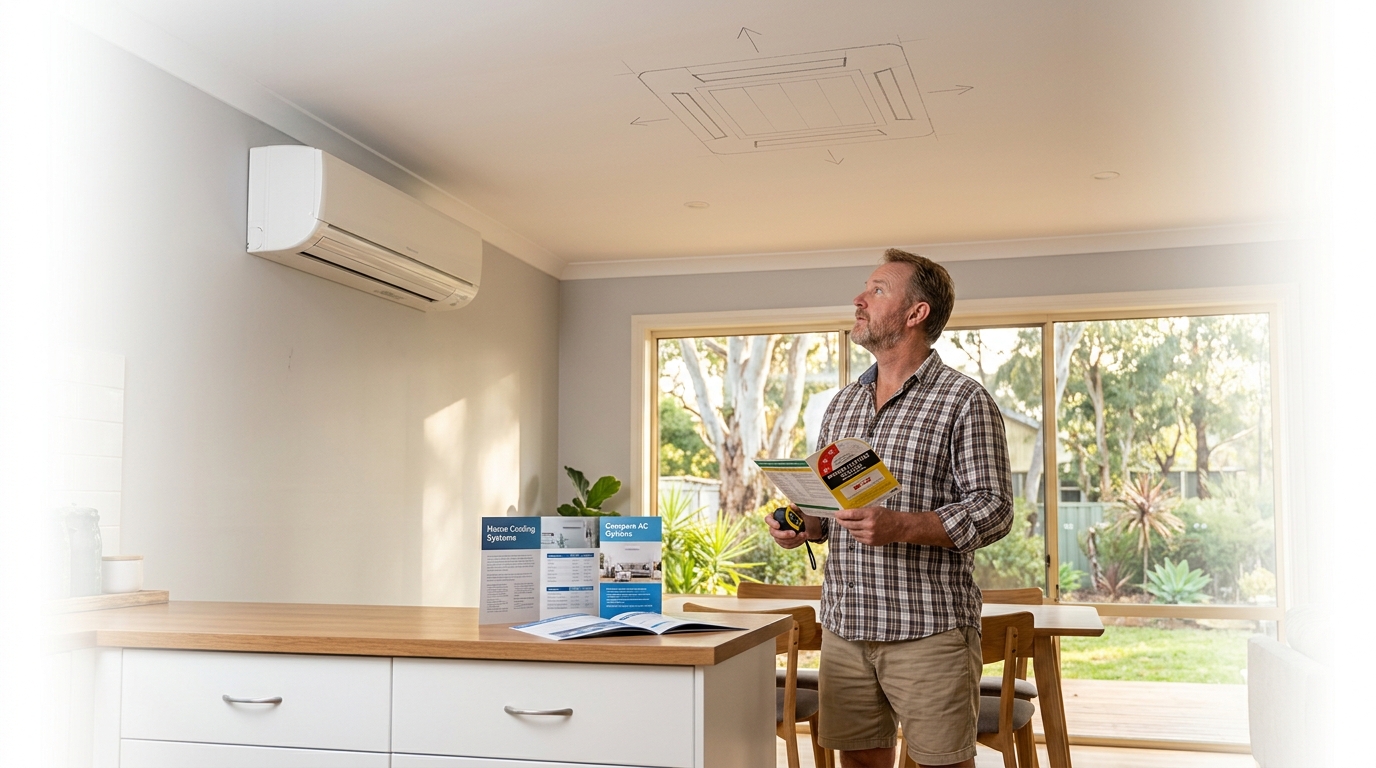
A cassette air conditioner mounts flush into the ceiling and pushes conditioned air outward through louvres in two or four directions, spreading airflow evenly across the room. A wall-mounted split system fixes an indoor head unit to a wall and blows air in a single horizontal direction, with the outdoor compressor sitting outside as usual.
This article covers the key differences across cost, installation complexity, airflow coverage, aesthetics and the situations where each system genuinely makes sense.
Key takeaways
- Cassette air conditioners offer multi-directional airflow but cost twice as much as split systems.
- Split systems are more affordable, easier to install and work in virtually any room.
- Choose cassette units for large open-plan spaces over 40sqm with ceiling cavities.
- Wall-mounted split systems suit bedrooms, apartments and rooms without ceiling access.
How Each System Works
Both cassette and wall-mounted split systems use the same fundamental refrigeration cycle: an indoor unit absorbs heat from the room air and transfers it to an outdoor compressor unit via refrigerant lines. The difference lies entirely in how the indoor unit is positioned and how it distributes that conditioned air. Both types are available as reverse-cycle systems, meaning they provide heating in winter and cooling in summer from the one unit.
Cassette Units: Ceiling-Mounted, Multi-Directional Airflow
A cassette indoor unit sits recessed into the ceiling so that only the flat grille panel is visible from below, flush with the ceiling tile or plasterboard. To install one, you need a ceiling cavity of at least 300mm above the mounting point, which rules out some older homes and apartments with shallow ceiling spaces.
The defining feature of a cassette is its airflow pattern. Air is drawn in through a central return grille and pushed out through louvres on two or four sides of the panel. This four-way distribution spreads conditioned air evenly in all directions, making cassette units particularly well suited to open-plan rooms and square-shaped spaces where a single-direction wall unit would leave corners under-served. The outdoor compressor connected to a cassette unit is functionally identical to the one paired with any standard split system.
Wall-Mounted Split Systems: Flexible and Widely Available
The wall-mounted indoor unit is surface-mounted high on a wall, typically 150mm to 200mm below the ceiling line. It draws room air across an internal coil and blows conditioned air outward in a single horizontal direction, relying on the room's natural air circulation to distribute it further. Louvres on the unit can be angled up or down to adjust throw, but the airflow remains fundamentally one-directional.
Split system air conditioners are available in a wide range of capacities, from around 2kW for a small bedroom up to 9.5kW for large living areas in residential applications. Because no ceiling cavity is required, installation is considerably simpler and less disruptive. That flexibility makes wall-mounted units the go-to choice for virtually any room type, including rentals, apartments and rooms with concrete slab ceilings where a cassette installation simply isn't possible.
Cassette vs Split System: Side-by-Side Comparison
At the same capacity, a cassette air conditioner typically costs more than twice as much as a wall-mounted split system before a single tradie sets foot in your home. The Daikin Cora 5kW Inverter Split System (FTXV50WVMA) retails from $1,697, while the equivalent Daikin FCA50CA-VC2V 5kW Premium Reverse Cycle Cassette System starts at $3,611. Add installation labour and ceiling work on top, and the gap widens considerably.
| Feature | Cassette AC | Wall-Mounted Split System |
|---|---|---|
| Supply & Installation Cost | $5,000–$8,000+ (unit plus ceiling work and labour) | $2,000–$4,000 (unit plus standard installation) |
| Ceiling Cavity Required | Yes. Minimum 300mm above mounting point | No. Surface-mounted to wall |
| Airflow Pattern | Two or four-way multi-directional | Single horizontal direction |
| Aesthetic Impact | Minimal. Flush ceiling grille only | Visible wall-mounted head unit |
| Ideal Room Shape | Square or open-plan spaces over 30sqm | Rectangular rooms of any size |
| Maintenance Access | Ceiling access required for servicing | Straightforward. Filters accessible at head unit |
The cost gap between the two system types is the single biggest factor for most homeowners. Cassette installation typically adds $1,500 to $3,000 or more in labour and ceiling work on top of the unit price, covering tasks like cutting the ceiling opening, framing the mounting point, running refrigerant lines through the cavity and patching any surrounding plasterboard. That means a 5kW cassette setup can easily land at $5,000 to $6,500 all-in, compared to $2,500 to $3,500 for a comparable wall-mounted split system fully installed.
Installation complexity is the other major differentiator. A wall-mounted split system can usually be installed in a few hours by a single licensed refrigeration mechanic. A cassette unit often requires a team, ceiling access and in some cases a builder or plasterer to finish the surrounding ceiling surface. If your home already has a suitable ceiling cavity from a previous renovation or is being built from scratch, that complexity drops significantly. Browse our range of Daikin split systems for pricing across all capacities if you want to compare the unit cost side by side before factoring in installation.
Which System Suits Your Home?
The right choice between a cassette unit and a wall-mounted split system comes down to four practical factors: the size and shape of the room, whether your home has a usable ceiling cavity, your budget and whether you are mid-renovation or retrofitting into an existing space. Neither system is universally better. Each has a clear home ground where it outperforms the other.
Cassette units are common in commercial settings like offices, retail spaces and restaurants, where open-plan layouts and a clean ceiling aesthetic are priorities. They are increasingly chosen for high-end residential open-plan homes for exactly the same reasons. Wall-mounted split systems, by contrast, remain the dominant choice for residential installations across Australia because they work in virtually any room without structural requirements.
When a Cassette AC Makes Sense
A cassette air conditioner is the right call when you have an open-plan room larger than 40sqm, a ceiling cavity of at least 300mm and either a renovation or new build underway where the unit can be planned into the ceiling from the start. The four-way airflow pattern genuinely earns its premium in these situations, delivering even temperature distribution that a single wall-mounted unit simply cannot match in a large square space.
Homeowners who prioritise a discreet, architecturally clean finish also find the cassette format worth the extra outlay. If you can see the ceiling grille and nothing else, the system disappears into the room in a way no wall-mounted unit can. The Daikin FCA71CA-CC2V 7.1kW Inverter Cassette System at $4,035 is a practical residential-scale example, suited to open-plan living and dining areas where you need solid heating and cooling capacity without a head unit dominating the wall.
When a Split System Is the Better Choice
For bedrooms, studies, apartments, rentals or any room without a ceiling cavity, a wall-mounted split system is the practical and cost-effective answer. Installation is straightforward, installer availability is broad and the units themselves are significantly more affordable at equivalent capacities. There is no ceiling work, no structural planning and no need to coordinate a builder alongside your air conditioning installer.
The Mitsubishi Electric AP Series 5kW Split System (MSZAP50VGKD) at $1,716 is a reliable, widely stocked option that covers most standard bedrooms and mid-sized living areas with ease. If you are on a tight budget or need to cool multiple separate rooms, the lower per-unit cost of split systems makes it feasible to install two or three units for the price of a single cassette setup. Our full range of Mitsubishi Electric split systems covers capacities from 2kW to 9kW to suit rooms of every size.
Frequently Asked Questions
Is cassette AC better than split AC?
Neither is universally better. Cassette air conditioners deliver more even, multi-directional airflow and a cleaner ceiling-flush aesthetic, making them the stronger choice for large open-plan spaces over 40sqm. Split systems are more affordable, easier to install and suit the vast majority of residential rooms. Before deciding, consider your room size, whether your home has a ceiling cavity of at least 300mm and how much you are prepared to spend on supply and installation.
What are the disadvantages of cassette AC?
The main disadvantages of cassette air conditioners are the higher upfront cost, the requirement for a ceiling cavity of at least 300mm, more complex installation and harder access for filter cleaning and routine servicing. Cassette units are also generally available only in larger capacity ranges, which makes them impractical and poor value for small rooms like bedrooms or studies. If your home does not have a suitable ceiling cavity, a cassette installation may not be possible at all without significant building work.
What is the $5,000 rule for AC?
The $5,000 rule is a general guideline used to decide whether to repair or replace an ageing air conditioner. Multiply the unit's age in years by the estimated repair cost. If the result exceeds $5,000, replacement is usually the more economical choice over the long term. This is a rule of thumb rather than an industry standard, and a qualified refrigeration technician's assessment should always guide the final decision, particularly for systems that are still under manufacturer warranty.
Are cassette air conditioners any good?
Yes, cassette air conditioners are an excellent choice for the right application. They offer efficient, even airflow across large spaces, a discreet ceiling-flush appearance and reliable performance from brands like Daikin and Mitsubishi Electric. The key is confirming your space has the ceiling cavity depth required and that the higher supply and installation cost fits your budget. In the right room, a cassette unit outperforms a wall-mounted split system on both comfort and aesthetics.
Ready to Choose? Browse Our Range
Cassette air conditioners offer superior aesthetics and even multi-directional airflow for larger open-plan spaces, but they come at a higher cost and require more complex installation. For most Australian homes, a wall-mounted split system remains the practical, affordable and flexible choice, covering everything from small bedrooms to large living areas without any structural requirements.
Air Conditioning Experts stocks both system types from leading brands including Daikin and Mitsubishi Electric, with competitive pricing and nationwide delivery across Australia. If you are still weighing up your options, our team is happy to help you find the right fit for your space and budget. Browse our full range of split system air conditioners or get in touch with our team for personalised advice.
Need expert advice?
Our team can help you choose the right air conditioning system for your space.