
Ceiling Cassette Air Conditioner: How It Works, Pros, Cons and Costs
What Is a Ceiling Cassette Air Conditioner?
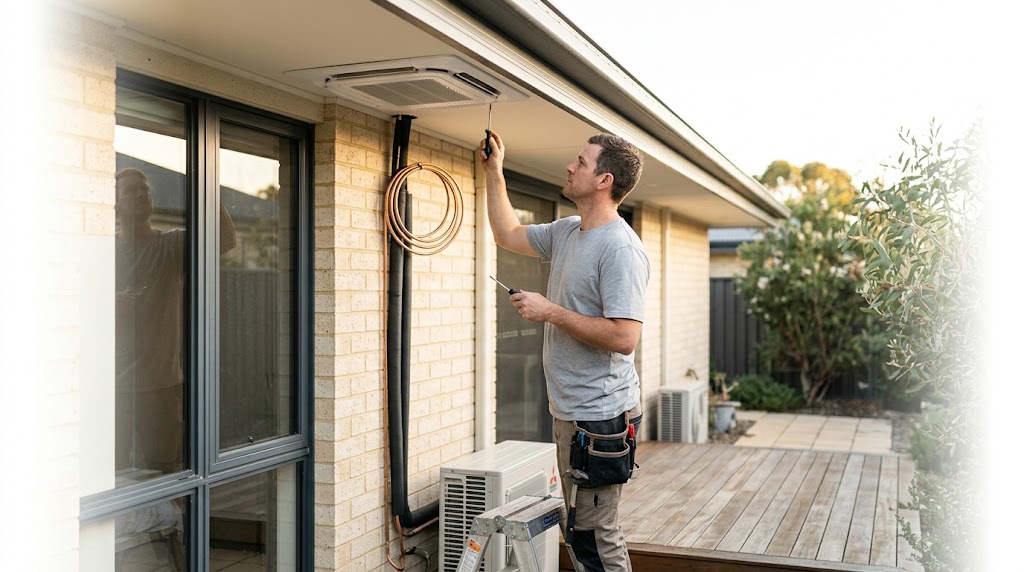
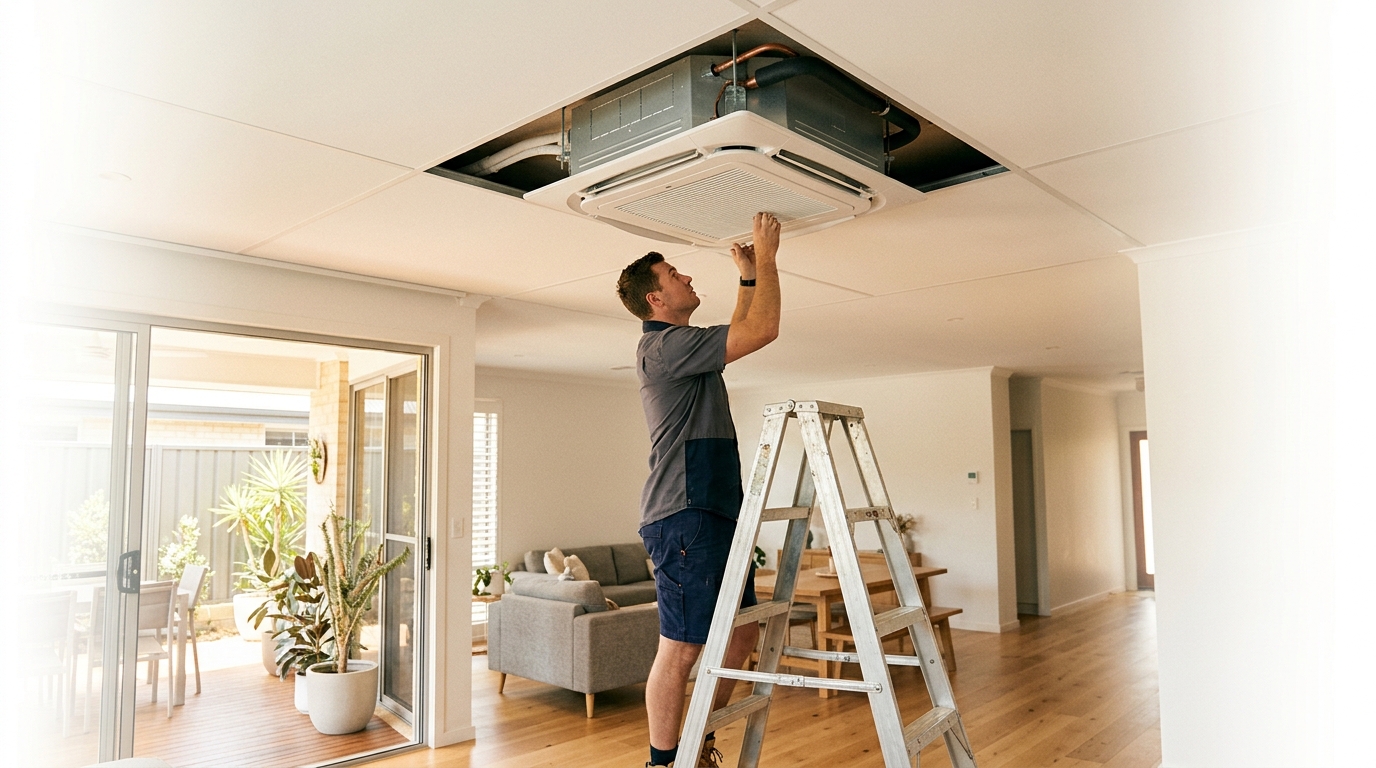
A ceiling cassette air conditioner is a type of reverse-cycle split system where the indoor unit is installed flush inside a suspended or false ceiling, leaving only a square grille panel visible from below. Unlike a wall-mounted split system that protrudes from the wall, the cassette unit sits entirely above the ceiling line, making it far less obtrusive in finished spaces. The outdoor compressor unit works exactly the same as any other split system.
Ceiling cassettes suit a wide range of applications. In residential settings they are popular in open-plan living areas, master bedrooms and new builds where a clean aesthetic matters. In commercial environments, offices, retail spaces and hospitality venues rely on them because they blend into the ceiling without dominating the room. This article covers how they work, their pros and cons, typical costs and how they compare to other system types.
Key takeaways
- A ceiling cassette air conditioner is a discreet split system installed above the ceiling with multi-directional airflow.
- They cost more than wall-mounted units but suit large open-plan spaces and commercial environments.
- Installation requires a ceiling cavity and professional setup, adding $1,500 to $3,000 to the total cost.
How Does a Ceiling Cassette Air Conditioner Work?
A ceiling cassette air conditioner works by drawing room air in through a central return air grille on the underside of the cassette panel, passing it over a refrigerant coil to heat or cool it, then discharging the conditioned air back into the room through directional vanes around the panel's perimeter. The refrigerant loop connects the indoor cassette to an outdoor compressor unit, which either releases heat in cooling mode or extracts heat from outside air in heating mode, just like a standard reverse-cycle split system.
Most modern cassette units use inverter compressor technology. Rather than switching the compressor on and off at full power, an inverter modulates the compressor speed to match the actual heating or cooling load in the room. This means the system ramps down once the target temperature is reached and maintains it with minimal energy use, rather than cycling on and off repeatedly. The practical result is lower running costs and more consistent room temperatures.
The key operational difference between a ceiling cassette and a wall-mounted split system is airflow direction. A wall-mounted unit blows conditioned air in a single direction across the room. A cassette unit discharges air through two or four vanes positioned around the panel, spreading airflow across the room simultaneously from a central point. This multi-directional discharge is what makes cassettes particularly effective in large or square-shaped rooms where a single-direction unit would leave corners under-served.
Two-Way vs Four-Way Airflow
Ceiling cassette units are available in two-way and four-way airflow configurations. Two-way models discharge air in two opposite directions and are best suited to narrow rooms, corridors or corner installations where airflow only needs to cover a rectangular zone. Four-way models are the most common choice and discharge air in all four directions simultaneously, making them ideal for square rooms and large open-plan spaces.
Four-way airflow significantly reduces hot and cold spots because conditioned air reaches all corners of the room from a single central unit. Some premium models offer individual vane control per direction, so you can reduce airflow toward a window wall in winter or redirect it away from a workstation. If you are unsure which configuration suits your space, the room's shape and dimensions are the deciding factor.
Pros and Cons of a Ceiling Cassette Air Conditioner
Ceiling cassette air conditioners offer genuine advantages over wall-mounted units in the right setting, but they also come with real trade-offs around cost, installation requirements and servicing. Understanding both sides helps you decide whether a cassette unit is the right fit for your space or whether a simpler system will do the job better.
Advantages of Ceiling Cassette Units
- Discreet, space-saving design. Only the square grille panel is visible from inside the room. The entire mechanical unit sits above the ceiling line, so you keep all your wall space free. This matters in rooms where furniture placement, windows or artwork make a wall-mounted unit awkward to position.
- Even, 360-degree airflow. Four-way discharge vanes push conditioned air outward in all directions simultaneously from a central point. This eliminates the dead zones and temperature gradients that a single-direction wall unit can leave in large or square-shaped rooms.
- Quieter operation in the living space. Because the bulk of the indoor unit sits above the ceiling, the mechanical noise from the fan and coil is muffled by the ceiling structure. The result is a noticeably quieter experience compared to a wall-mounted unit of equivalent capacity.
- Ideal for open-plan and commercial spaces. A single cassette unit can cover a large area effectively, making it a practical choice for open-plan living areas, offices, retail floors and hospitality venues where a wall-mounted unit would struggle to distribute air evenly.
- No large wall penetration required. Installation only needs a small hole for refrigerant lines and cabling, rather than the larger core hole a wall-mounted split system requires. This is a significant advantage in heritage buildings, tiled feature walls or any space where drilling a large hole through the wall is problematic or prohibited.
Disadvantages of Ceiling Cassette Units
- Higher installation cost. Installing a ceiling cassette involves more labour than a standard wall-mounted split system. The installer needs to cut a ceiling opening, fit a mounting frame, ensure adequate structural support and connect the unit above the ceiling line. Expect to pay noticeably more for installation alone, before factoring in the unit price.
- Ceiling cavity is non-negotiable. A cassette unit requires a roof void or suspended ceiling with enough depth to house the indoor unit, typically at least 300mm of clearance. Homes with concrete slab ceilings or no accessible ceiling cavity simply cannot accommodate a cassette unit without major structural work.
- More complex servicing. Filters on a cassette unit are accessible from below, which is straightforward. However, coil cleaning and deeper maintenance still require a technician to access the unit from above the ceiling, which adds time and cost to each service visit compared to a wall-mounted unit.
- Condensate drainage adds complexity. Cassette units produce condensate that must be removed via a gravity drain or a condensate pump. If gravity drainage is not possible due to ceiling height or building layout, a pump is required. Pumps add to the installation cost and introduce an additional component that can fail over time.
- Higher purchase price than equivalent wall-mounted units. A ceiling cassette of similar cooling capacity will cost more than a comparable wall-mounted split system air conditioners. For context, the Daikin 6kW Inverter Split System Lite FTXF60WVMA is priced at $1,793. A ceiling cassette of equivalent output will typically cost several hundred dollars more before installation is factored in, making the total outlay considerably higher.
Ceiling Cassette vs Split System: Which Should You Choose?
A ceiling cassette and a wall-mounted split system both use the same refrigerant-based technology to heat and cool a room, but they suit very different situations. The table below compares the two side by side across the factors that matter most to buyers.
| Feature | Ceiling Cassette | Wall-Mounted Split System |
|---|---|---|
| Typical unit price (AUD) | $2,000 to $4,500+ | $800 to $2,500 |
| Installation complexity | High (ceiling access, structural support, condensate drainage) | Low to moderate (wall bracket, refrigerant lines, core hole) |
| Ceiling cavity required | Yes (minimum ~300mm clearance) | No |
| Airflow direction | Two-way or four-way (360 degrees) | Single direction |
| Best suited for | Open-plan areas, commercial spaces, rooms over 40 sqm | Bedrooms, smaller rooms, budget-conscious buyers |
| Noise level (indoor) | Lower (unit is above ceiling line) | Moderate (unit is in the room) |
Choose a ceiling cassette if you are conditioning an open-plan living area larger than 40 sqm, a commercial space, or any room where wall space is limited and aesthetics matter. The four-way airflow genuinely outperforms a wall-mounted unit in large square rooms, and the discreet installation is hard to beat in a high-end fitout. For a concrete price comparison, the Daikin 5kW Inverter Split System Lite FTXF50WVMA is $1,589 as a wall-mounted unit. A ceiling cassette of similar capacity will cost meaningfully more, so the premium needs to be justified by your room size and requirements.
Choose a wall-mounted split system for standard bedrooms, smaller living areas or any situation where budget is the primary concern. The installation is simpler, the units are cheaper and servicing is more straightforward. For most Australian homes with one or two rooms to condition, a quality wall-mounted split system is the more practical and cost-effective solution.
If you need to condition multiple rooms or an entire home, a third option is worth considering. Ducted air conditioners distribute conditioned air through ceiling vents across the whole house from a single outdoor unit, giving you whole-home climate control with no visible indoor units at all. Daikin ducted systems are a popular choice here, with the Daikin 7.1kW Inverter Ducted Air Conditioner FDYAN71 starting at $3,319. That price point puts a ducted system in a similar bracket to a ceiling cassette installation, making it worth comparing both options if you are planning a larger project.
How Much Does a Ceiling Cassette Air Conditioner Cost in Australia?
A ceiling cassette air conditioner in Australia typically costs between $2,700 and $5,500 fully installed, covering the unit itself plus labour. That figure breaks down across three components: the unit purchase price, the installation cost and the ongoing running costs. Each component varies depending on the brand, capacity, building conditions and your location.
Unit Cost
For residential capacities between 5kW and 10kW, entry-level cassette units from brands like Daikin, Mitsubishi Electric and Fujitsu generally range from $1,200 to $2,500. Commercial-grade units with higher capacities or more advanced controls can reach $3,500 or more. For context, the Daikin 7.1kW Inverter Ducted Air Conditioner FDYAN71 is priced at $3,319, which puts a ceiling cassette installation in a similar price bracket to entry-level ducted systems. That comparison is worth keeping in mind if you are weighing up your options for a larger space.
Installation Cost
Installation typically adds $1,500 to $3,000 on top of the unit price. The final figure depends on how accessible your ceiling cavity is, how far the indoor unit sits from the outdoor compressor and whether a condensate pump is needed. Difficult ceiling access, long refrigerant line runs and pump requirements all push the cost toward the higher end. Getting at least two quotes from licensed installers is the best way to avoid overpaying, as labour rates vary considerably between contractors and states.
Running Costs
Modern inverter cassette units are genuinely energy-efficient in day-to-day use. A 7kW unit running eight hours per day at the Australian average electricity rate of approximately $0.30 per kWh costs roughly $5 to $7 per day to run. That works out to around $150 to $210 per month during heavy use periods, though actual costs vary by state, tariff structure and how hard the unit is working. Homes in Queensland and South Australia tend to see higher summer running costs simply due to the longer cooling season and higher peak temperatures.
Is a Ceiling Cassette Air Conditioner Right for Your Home?
Ceiling cassette units genuinely excel in open-plan spaces and commercial settings where even airflow and a discreet appearance matter. However, they cost more to buy and install than a wall-mounted split system, and they require a suitable ceiling cavity that many Australian homes simply do not have. For most standard bedrooms and living rooms, a quality wall-mounted split system delivers excellent results at a meaningfully lower price.
If you have decided a cassette is the right fit, get at least two quotes from licensed installers before committing. If you are still weighing up your options, browse our range of split systems to compare capacities and prices across leading brands. Not sure which system suits your space? Get in touch with our team and we will help you find the right solution for your home or business.
Frequently Asked Questions
How long does a ceiling cassette air conditioner last?
A ceiling cassette air conditioner typically lasts 15 to 20 years with regular servicing. Annual filter cleaning and a professional coil service every two to three years are the main factors that determine longevity. Units from established brands like Daikin, Mitsubishi Electric and Fujitsu tend to reach the upper end of that range when maintained properly.
Do ceiling cassette air conditioners need a drain?
Yes, ceiling cassette units produce condensate during cooling and require a drainage solution. Where the ceiling height and building layout allow, a gravity drain is the simplest and most reliable option. If gravity drainage is not possible, a condensate pump is installed to remove the water mechanically. Pump failure is one of the more common service issues with cassette units, so it is worth factoring into your maintenance budget.
Can a ceiling cassette air conditioner heat as well as cool?
Yes. Most ceiling cassette units sold in Australia are reverse-cycle systems, meaning they provide both heating and cooling from the same unit. In heating mode, the system extracts heat from outside air and transfers it into the room, which is far more energy-efficient than a resistive electric heater. This makes them a practical year-round solution in most Australian climate zones.
How much does it cost to install a ceiling cassette air conditioner?
Installation typically costs between $1,500 and $3,000 on top of the unit price, bringing the total installed cost to roughly $2,700 to $5,500 for most residential applications. The final figure depends on ceiling cavity accessibility, the distance between the indoor and outdoor units, and whether a condensate pump is required. Getting two or three quotes from licensed installers is the best way to find a fair price in your area.
What size ceiling cassette do I need?
Room size is the primary guide. As a rough rule, allow approximately 125 to 150 watts of cooling capacity per square metre for a well-insulated Australian home. A 40 sqm open-plan living area would typically need a 5kW to 6kW unit, while a larger 60 sqm space may require 7kW to 8kW. Ceiling height, insulation quality, window area and local climate all affect the final sizing, so a load calculation from a qualified installer is always recommended before purchasing.
Are ceiling cassette air conditioners noisy?
Ceiling cassette units are generally quieter inside the room than wall-mounted split systems of equivalent capacity. Because the mechanical components sit above the ceiling line, the ceiling structure absorbs much of the fan and coil noise. Most residential cassette units operate at around 30 to 38 decibels at low speed, which is comparable to a quiet conversation. The outdoor compressor produces similar noise levels to any other split system outdoor unit.
Can a ceiling cassette be installed in a home without a false ceiling?
A ceiling cassette requires a ceiling cavity of at least 300mm to house the indoor unit above the ceiling line. Homes with concrete slab ceilings or no accessible roof void cannot accommodate a cassette unit without significant structural work. In these situations, a wall-mounted split system is the practical alternative, as it requires only a small core hole through the wall rather than a ceiling cavity.
Need expert advice?
Our team can help you choose the right air conditioning system for your space.