
Evaporative Cooling vs Air Conditioning: Which Is Better for Australian Homes?
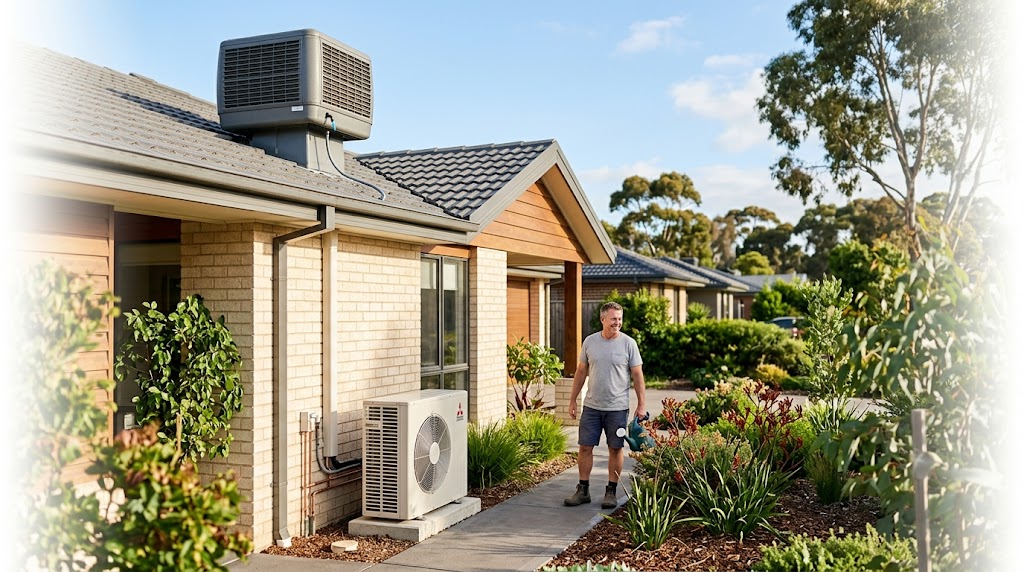
Evaporative Cooling vs Air Conditioning: Understanding the Basics
Australian summers are relentless, and for many homeowners the biggest cooling decision they face is choosing between evaporative cooling vs air conditioning. These are two fundamentally different technologies, each with its own strengths, limitations and running costs. Picking the wrong one for your climate or home can mean years of discomfort and wasted money.
Evaporative coolers work by drawing hot outside air through water-saturated pads. As the air passes through, water evaporates and the air temperature drops before being pushed into your home. It is a simple, low-energy process that works brilliantly in dry conditions.
Refrigerative air conditioners use a compressor and refrigerant cycle to extract heat and moisture from indoor air, then expel that heat outside. The result is cool, dry air regardless of what the weather is doing outdoors.
This article compares both systems across upfront cost, climate suitability, air quality and running costs so you can make a confident decision before you spend a cent.
Key takeaways
- Evaporative cooling vs air conditioning depends on your climate, with refrigerative systems working in all Australian regions.
- Evaporative coolers cost less upfront but only work effectively in dry inland areas.
- Refrigerative split systems offer year-round heating and cooling with better air quality control.
How Each System Works and What It Costs to Buy
Split system air conditioners are the most popular form of refrigerative cooling in Australian homes. Understanding how they differ from evaporative coolers at a mechanical level makes the cost comparison much easier to interpret.
An evaporative cooler pulls warm outside air through wet cellulose or synthetic pads. The water absorbs heat as it evaporates, dropping the air temperature by anywhere from 6 to 12 degrees Celsius before it enters the room. The system needs a constant supply of fresh outside air and an open window or vent to let stale air escape. Running costs are low because the only real energy draw is a fan motor and a small water pump.
A refrigerative split system works on a closed-loop refrigerant cycle. The indoor unit absorbs heat from your room air, the refrigerant carries that heat to the outdoor compressor unit, and the heat is expelled outside. The indoor air is simultaneously dehumidified, which is why a split system feels cool even on a muggy day. Inverter-driven compressors, which are now standard across most brands, adjust their speed continuously to maintain your set temperature without cycling on and off, keeping energy use efficient.
For a straightforward entry point into refrigerative cooling, the Daikin Lite 2.5kW (FTXF25WVMA) is priced at $989 and suits smaller rooms up to around 20 square metres. Larger inverter split systems scale up from there, with mid-range models sitting in the $1,500 to $2,085 range depending on capacity and features.
Evaporative systems are not stocked by Air Conditioning Experts, so if you are weighing up both options this article is designed to help you decide which direction suits your home before you start comparing specific products.
Upfront Purchase and Installation Costs
The table below gives a fast side-by-side look at what each system typically costs to buy and install across Australia. Note that refrigerative systems require a licensed refrigerant handling technician for installation, which adds to the labour cost compared to evaporative systems.
| Category | Evaporative Cooling | Refrigerative Air Conditioning |
|---|---|---|
| System Type | Ducted rooftop or portable/window unit | Split system (wall-mounted) or ducted |
| Typical Unit Cost (AUD) | $500 to $2,500 (portable to ducted) | $989 to $2,085+ (split system); from $2,798 (ducted 5kW) |
| Typical Installation Cost (AUD) | $500 to $1,500 (ducted rooftop) | $600 to $1,500+ (split system); $3,000+ (ducted) |
| Heating Capability | No | Yes (reverse cycle models heat and cool) |
The headline takeaway is that evaporative systems can be cheaper to buy and install upfront, particularly for ducted whole-home coverage. However, refrigerative split systems offer reverse-cycle heating as standard on most models, meaning you get a year-round climate control solution from a single unit. That dual functionality often makes the higher upfront cost of a refrigerative system the better long-term investment for most Australian households.
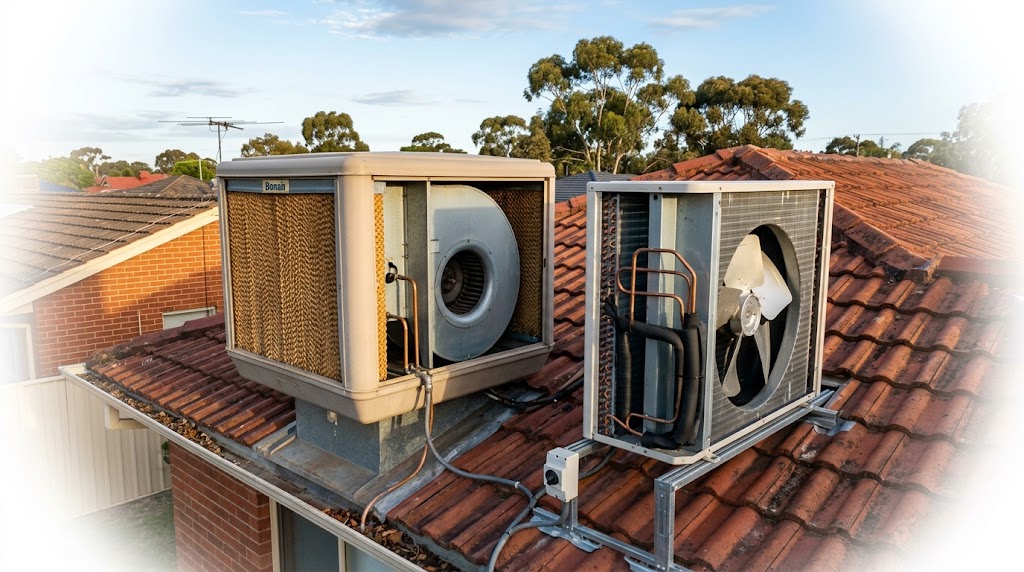
Climate Suitability: Where Each System Performs Best
Australia's climate varies so dramatically from region to region that climate suitability is the single most important factor in choosing between evaporative cooling and refrigerative air conditioning. Evaporative coolers perform well in hot, dry inland areas where humidity is low, but lose effectiveness rapidly as humidity rises. Daikin split systems and other refrigerative options work effectively in every Australian climate, making them the safer all-round choice for most households.
Hot and Dry Climates (SA, WA, Inland VIC and NSW)
In South Australia, Western Australia and the inland regions of Victoria and New South Wales, evaporative cooling can be a genuinely cost-effective solution. On a typical hot summer day in Adelaide or Broken Hill, relative humidity often sits below 30%, which is the sweet spot for evaporative technology. At that humidity level, the evaporation process is efficient and the cooler can drop indoor temperatures by up to 12 degrees Celsius.
For budget-conscious homeowners in these regions, evaporative cooling is a legitimate option worth considering. The upfront and running costs are lower, and the technology is well-suited to the local conditions. The honest caveat is that on extreme days above 40 degrees, even dry-climate evaporative coolers struggle to keep pace. When a heatwave pushes temperatures into the mid-40s, the air is often drier but the sheer heat load overwhelms the system's capacity to cool adequately.
Humid and Coastal Climates (QLD, Northern NSW, NT)
In Queensland, the Northern Territory, coastal New South Wales and tropical parts of Western Australia, evaporative cooling is largely ineffective. Once relative humidity climbs above 50 to 60%, the evaporation process slows dramatically because the air is already carrying a heavy moisture load. At 70 to 80% humidity, a running evaporative cooler can actually add moisture to your indoor air, making the space feel more oppressive rather than less.
Refrigerative air conditioning is the clear choice for these climates. A reverse-cycle split system not only cools the air but actively dehumidifies it, which is what makes a 28-degree Brisbane day feel genuinely comfortable indoors. The Daikin Cora 5kW (FTXV50WVMA) at $1,697 is a well-rounded option for medium-sized living areas in these regions, offering strong cooling capacity alongside reverse-cycle heating for cooler months.
It is also worth noting the fundamental operating difference between the two systems. Evaporative coolers require open windows or vents to create an airflow path through the home. Refrigerative systems work best in a sealed room where the cooled air is retained. In a humid coastal climate, opening windows to run an evaporative cooler simply draws more humid air inside, compounding the problem.
Running Costs, Energy Efficiency and Environmental Impact
Evaporative coolers use considerably less electricity than refrigerative air conditioners, but the full running cost picture is more nuanced than the power bill alone. A ducted evaporative unit typically draws 150 to 500 watts, compared to 1,000 to 3,500 watts for a comparable refrigerative system. For homeowners in dry climates who run cooling for long hours each day, that difference adds up quickly over a summer.
The comparison shifts when you factor in how each system is actually used. A refrigerative split system cools a sealed room quickly and can then be turned down or switched off. An evaporative cooler needs continuous airflow to maintain temperature, which means it often runs for longer periods. In practice, the real-world energy gap between the two technologies is narrower than the raw wattage figures suggest.
Modern inverter split systems have closed the efficiency gap considerably. Inverter technology adjusts compressor speed continuously rather than cycling on and off at full power, which dramatically reduces energy consumption during the long periods when the system is simply maintaining a set temperature. The Daikin Lite 3.5kW (FTXF35WVMA) at $1,194 is a strong example of this, offering inverter-driven efficiency in a mid-sized unit that suits rooms up to around 30 square metres. For households prioritising lower running costs, an inverter split system is a far more efficient choice than older non-inverter refrigerative units.
The table below compares the two systems across the key running cost and environmental factors.
| Factor | Evaporative Cooling | Refrigerative Air Conditioning |
|---|---|---|
| Typical Power Draw | 150 to 500W (ducted) | 1,000 to 3,500W (split system) |
| Inverter Technology | Not applicable (fan-based) | Standard on most modern split systems |
| Water Consumption | 25 to 35 litres per hour | None |
| Refrigerant Use | None | R-32 (low GWP) on most modern units |
| Heating Capability | No | Yes (reverse cycle) |
On the environmental side, evaporative coolers use no refrigerant, which gives them a lower global warming potential from a refrigerant-leak perspective. However, most modern refrigerative split systems now use R-32 refrigerant, which has a global warming potential roughly 68% lower than the older R-410A it replaced. The environmental advantage of evaporative cooling has narrowed as a result.
Water consumption is a hidden running cost that many homeowners overlook. At 25 to 35 litres per hour, a ducted evaporative cooler running for eight hours a day can consume 200 to 280 litres of water daily. In drought-prone regions of inland Australia, that is a meaningful cost and a genuine sustainability consideration, particularly during water restrictions. Ducted air conditioners use no water at all, which is worth factoring into the total cost of ownership for whole-home cooling.
Air Quality, Allergies and Maintenance Requirements
For allergy and asthma sufferers, refrigerative air conditioning is generally the better choice over evaporative cooling. Refrigerative split systems recirculate and filter indoor air through a sealed system, while evaporative coolers continuously draw in fresh outside air, which also brings pollen, dust, smoke and other outdoor pollutants directly into your living space.
That constant intake of outside air is one of evaporative cooling's selling points in terms of freshness, but it is a genuine problem for anyone with hay fever, asthma or dust allergies. On high pollen days or during bushfire smoke events, an evaporative cooler offers no protection at all. You are essentially pumping the outdoor air quality, whatever it happens to be, straight into your home.
The wet pads inside an evaporative cooler also create a maintenance obligation that many homeowners underestimate. Because the pads stay damp throughout the cooling season, they can harbour mould, bacteria and mineral deposits if not cleaned regularly. Most manufacturers recommend cleaning the pads every one to two weeks during summer and replacing them entirely at the end of each season. Skipping that maintenance does not just reduce cooling performance, it actively degrades the air quality being pushed into your home.
Refrigerative split systems handle air quality very differently. The system is sealed, so outdoor pollutants stay outside. Quality models include multi-stage filtration that captures dust, pollen and some airborne bacteria before the air is recirculated back into the room. Daikin's streamer discharge technology, available across several of their split system ranges, actively breaks down allergens and deactivates certain bacteria and viruses rather than simply trapping them in a filter.
The maintenance requirement for a refrigerative system is straightforward. Filters should be cleaned every two to four weeks during periods of heavy use, which typically takes a few minutes with a vacuum or a rinse under the tap. Beyond that, the system is sealed and does not require the seasonal pad replacements or tank cleaning that evaporative coolers demand.
| Factor | Evaporative Cooling | Refrigerative Air Conditioning |
|---|---|---|
| Outdoor Air Intake | Continuous, unfiltered | None (sealed system) |
| Pollen and Dust Protection | None | Yes, via multi-stage filtration |
| Mould and Bacteria Risk | Higher (wet pads) | Lower (dry, sealed system) |
| Filter Cleaning Frequency | Pads every 1 to 2 weeks; annual replacement | Every 2 to 4 weeks (quick rinse) |
| Suitable for Allergy Sufferers | Generally not recommended | Yes, particularly models with advanced filtration |
Which System Is Right for Your Home?
The right cooling system depends on where you live, how you use it and what matters most to you. If you are in a hot, dry inland climate and cooling costs are your primary concern, evaporative cooling can be a cost-effective summer solution worth considering. The lower upfront cost and minimal running costs make it a practical choice for the right conditions.
For most Australian households, a refrigerative split system or ducted system is the stronger long-term investment. If you live in a humid or coastal area, experience high pollen seasons, need reliable performance on extreme heat days above 40 degrees, or want a single system that handles both heating and cooling year-round, refrigerative air conditioning covers all of those needs where evaporative cooling falls short.
Ready to find the right system for your home? Browse our range of split system air conditioners to compare capacities, brands and prices across Australia's most trusted cooling brands.
Frequently Asked Questions
Is evaporative cooling cheaper to run than air conditioning?
Yes, evaporative cooling is cheaper to run in dry climates, typically drawing 150 to 500 watts compared to 1,000 to 3,500 watts for a refrigerative split system. However, evaporative coolers run for longer periods and also consume 25 to 35 litres of water per hour. In humid climates, they are largely ineffective, so the running cost comparison only holds where the technology actually works.
Can evaporative cooling work in humid weather?
Evaporative cooling does not work effectively in humid weather. Once relative humidity rises above 50 to 60%, the evaporation process slows significantly because the air is already saturated with moisture. In tropical and coastal regions like Queensland and the Northern Territory, a refrigerative air conditioner is the only reliable option for genuine comfort.
Does evaporative cooling increase humidity inside the home?
Yes, evaporative cooling adds moisture to indoor air as part of how it works. In dry climates this is generally not a problem and can even feel comfortable. In already-humid conditions, running an evaporative cooler can push indoor humidity higher and make the space feel more oppressive rather than cooler.
Which is better for allergies, evaporative cooling or air conditioning?
Refrigerative air conditioning is better for allergy and asthma sufferers. Evaporative coolers continuously draw in unfiltered outside air, bringing pollen, dust and smoke directly into your home. Refrigerative split systems operate as a sealed system, recirculating and filtering indoor air without any outdoor air intake. Models with advanced filtration, such as those with Daikin's streamer discharge technology, offer an additional layer of allergen control.
Do I need to leave windows open with evaporative cooling?
Yes, evaporative coolers require open windows or vents to function properly. The system works by pushing a continuous flow of cooled air into the home, and that air needs somewhere to escape. Without an open window or vent, the airflow stalls and cooling performance drops sharply. This is the opposite of how refrigerative air conditioning works, which performs best in a sealed, closed room.
How long do evaporative coolers last compared to air conditioners?
A well-maintained ducted evaporative cooler typically lasts 10 to 15 years. Refrigerative split systems have a similar lifespan, with quality inverter units from brands like Daikin often running reliably for 15 years or more with regular filter cleaning. Evaporative coolers require more seasonal maintenance, including annual pad replacement, which adds to the ongoing cost of ownership over that lifespan.
Can I use evaporative cooling and air conditioning together?
Running both systems simultaneously is not recommended. Evaporative coolers need open windows to work, which defeats the sealed environment a refrigerative system requires to cool efficiently. Some households use evaporative cooling on mild dry days and switch to refrigerative air conditioning on extreme heat days or during humid periods, treating them as separate seasonal tools rather than running them at the same time.
Need expert advice?
Our team can help you choose the right air conditioning system for your space.