
How Does a Cassette Air Conditioner Work? A Complete Guide

How Does a Cassette Air Conditioner Work?
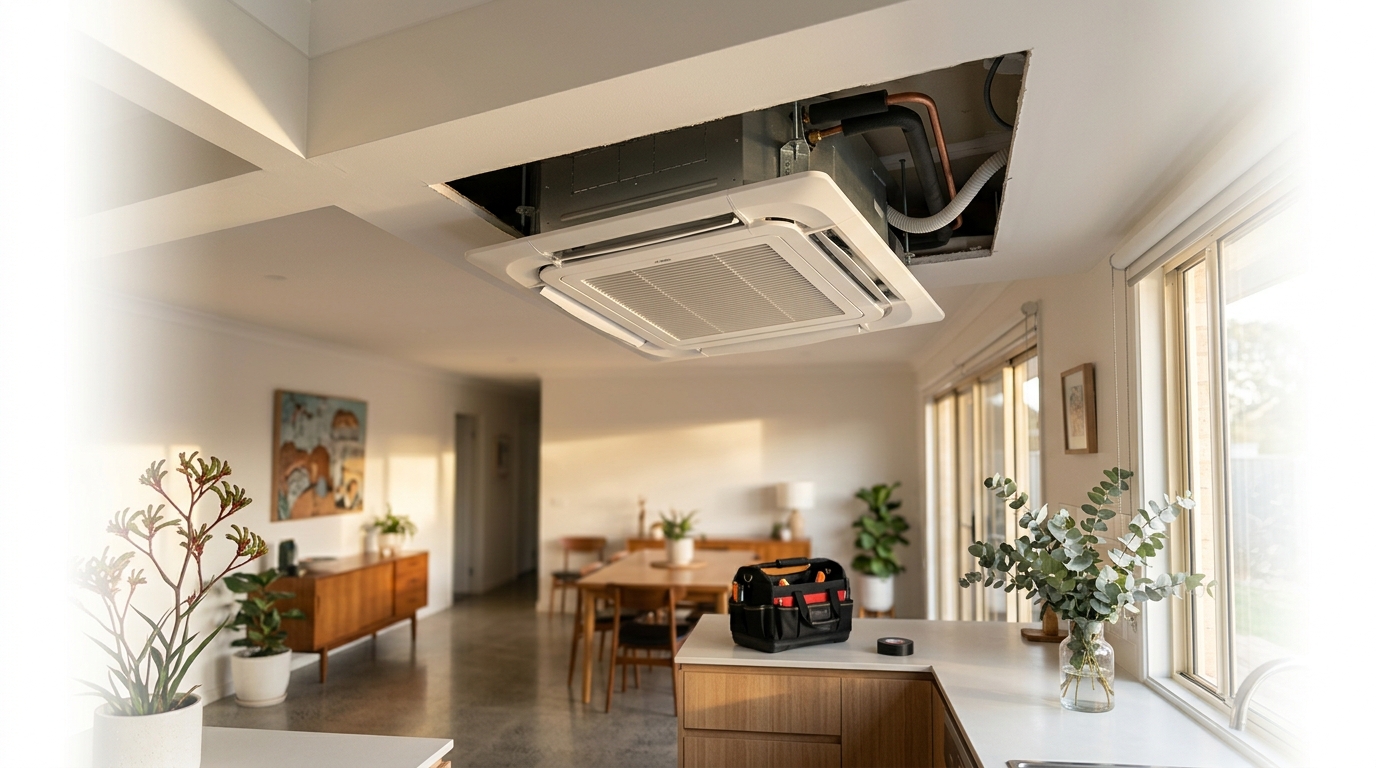
A cassette air conditioner is a ceiling-mounted split system that recesses into the ceiling cavity, leaving only a flat grille visible from inside the room. Unlike a wall-mounted split system, a cassette unit draws warm room air down through a central return grille, passes it over a refrigerant-cooled evaporator coil, and then redistributes the conditioned air outward through up to four directional vents. This 360-degree airflow pattern makes cassette units a popular choice for open-plan homes, offices and commercial spaces where even air distribution matters.
The core process follows the standard refrigeration cycle. Refrigerant absorbs heat from the indoor air at the evaporator coil, travels to the outdoor condenser unit where that heat is released outside, then returns to repeat the cycle. The result is a steady supply of cooled or heated air delivered quietly from above.
The sections below cover the key components inside and outside the unit, how the airflow and drainage systems work, the honest pros and cons of cassette systems, and which buyers are best suited to them.
Key takeaways
- A cassette air conditioner works by drawing air through a ceiling-mounted unit and distributing it in multiple directions via motorised louvres.
- Cassette systems suit open-plan spaces where even air distribution and discreet aesthetics matter most.
- Installation requires at least 300mm of ceiling void space and proper drainage planning.
Key Components of a Ceiling Cassette System
A ceiling cassette air conditioner is made up of two main units connected by refrigerant lines: the indoor cassette panel recessed into the ceiling and the outdoor condenser unit mounted at ground level or on a wall bracket. Understanding what each component does helps explain why cassette systems perform the way they do, and why they suit certain spaces better than others.
Indoor Unit: The Cassette Panel
The indoor cassette body sits inside the ceiling cavity, supported by a suspension frame that drops down from the structural ceiling. From inside the room, the only visible part is the decorative grille panel, which typically measures around 600 x 600 mm and aligns flush with the ceiling tiles or plasterboard. This discreet profile is one of the main reasons cassette units are favoured in commercial fit-outs and open-plan residential spaces.
Inside the cassette body, the evaporator coil is the heart of the cooling process. Refrigerant flowing through the coil absorbs heat from the room air passing over it, dropping the air temperature before it is redistributed into the space. A centrifugal blower fan draws air downward through a central return air grille in the middle of the panel, then pushes the conditioned air outward through the louvres around the perimeter.
Most cassette units offer two-way or four-way airflow, with motorised louvres that can be angled independently to direct air across the room evenly. This multi-directional delivery is a significant advantage over wall-mounted units, which project air in a single direction and can leave corners of a large room undertreated.
A washable filter panel sits behind the return grille and captures dust, hair and airborne particles before they reach the evaporator coil. Regular cleaning of this filter, typically every four to six weeks in a busy space, keeps airflow strong and efficiency high. A condensate drain pan beneath the evaporator coil collects moisture removed from the air during cooling, which is then piped away via a drain line.
Outdoor Unit: The Condenser
The outdoor condenser unit houses the three components that complete the refrigeration cycle: the compressor, the condenser coil and the expansion valve. The compressor pressurises the refrigerant gas, raising its temperature so it can release heat effectively at the condenser coil. A large fan draws outside air across the condenser coil, carrying that extracted heat away from the building.
Modern cassette systems use inverter compressor technology, which means the compressor modulates its speed continuously to match the cooling or heating load rather than switching fully on and off. This keeps the room temperature stable and reduces energy consumption compared to older fixed-speed compressors, which would overshoot the set temperature before cutting out.
The expansion valve sits between the condenser and the evaporator coil. It drops the pressure of the refrigerant rapidly, cooling it down before it re-enters the indoor unit to absorb heat again. Most current models, including the Daikin FCA100C-CC2V 10kW Inverter Cassette (R32) System priced at $4,885, use R32 refrigerant. R32 has a global warming potential roughly 68% lower than the older R410A refrigerant it has largely replaced in the Australian market, making it a more environmentally responsible choice.
The outdoor unit connects to the indoor cassette via two refrigerant lines (a suction line and a liquid line) bundled together with the power cable and the condensate drain pipe. These lines run through the ceiling cavity and down an exterior wall, typically concealed in a PVC conduit for a tidy finish.
Airflow and Drainage: How the System Manages Air and Water
A ceiling cassette manages two simultaneous processes during operation: distributing conditioned air evenly across the room and removing the moisture it extracts from that air. Warm air at ceiling level is drawn down through the central return grille, cooled across the evaporator coil, then pushed outward through motorised louvres around the panel perimeter. Condensation that forms on the evaporator coil during this process collects in a drain pan and is piped away continuously through the ceiling cavity.
The louvres on a cassette unit are motorised and adjustable, which gives installers and occupants control over where the conditioned air travels. Most models allow each louvre to be angled independently, so you can direct airflow away from desks, beds or seating areas where a direct draught would be uncomfortable. Some premium models include auto-swing louvres that oscillate continuously to distribute air across a wider area without concentrating airflow on any one spot.
Drainage is a common question for anyone considering a cassette installation. Moisture condensed on the evaporator coil drips into a shallow drain pan built into the base of the cassette body. From there, a condensate drain pipe carries the water through the ceiling cavity to an external drain point. Where gravity drainage is not possible, such as in a basement fit-out or a building with a flat ceiling void, a condensate pump is installed inside or alongside the cassette to push the water upward and away. Without a functioning drain, the pan will overflow and water will leak through the ceiling, so confirming the drainage path is a critical part of any cassette installation.
Two-Way vs Four-Way Airflow
The number of discharge directions a cassette offers has a direct impact on how evenly it heats or cools a room. Choosing the right configuration for your space avoids cold spots, warm corners and unnecessary draught complaints.
| Feature | Two-Way Cassette | Four-Way Cassette |
|---|---|---|
| Airflow directions | Two opposite sides of the panel | All four sides of the panel |
| Best room shape | Narrow or rectangular rooms | Square or large open-plan rooms |
| Coverage evenness | Good for corridor-style spaces | Superior for wide, open areas |
| Typical application | Smaller offices, narrow retail bays | Open-plan offices, restaurants, large living areas |
| Auto-swing louvres | Available on select models | Common on mid-range and premium models |
| Occupancy sensing | Rare | Available on premium models |
Some premium four-way models include occupancy sensors that detect where people are sitting in the room and redirect airflow away from those positions, reducing draught discomfort without sacrificing coverage. For most residential and light commercial applications, a four-way cassette is the more versatile choice. A two-way unit is worth considering only when the room layout genuinely suits it, such as a long narrow space where two-directional throw covers the full width without leaving dead zones.
Cassette Air Conditioner vs Split System: Which One Suits Your Space?
Choosing between a ceiling cassette and a standard wall-mounted split system air conditioners comes down to your room layout, ceiling construction and how visible you want the unit to be. Both systems use the same refrigeration cycle and connect to an outdoor condenser, but they deliver conditioned air in fundamentally different ways and suit different types of spaces.
| Feature | Ceiling Cassette | Wall-Mounted Split System |
|---|---|---|
| Airflow direction | Two-way or four-way from ceiling level | Single direction from wall-mounted unit |
| Visibility and aesthetics | Flush ceiling grille only, very discreet | Visible wall unit, more prominent |
| Installation complexity | Higher, requires ceiling void access and suspension frame | Lower, mounts directly to wall |
| Ceiling void required | Yes, minimum 300mm clearance | No ceiling void needed |
| Typical capacity range | 2.5kW to 14kW+ | 2.0kW to 9.0kW (residential) |
| Best suited for | Open-plan offices, retail, restaurants, large living areas | Bedrooms, standard living rooms, apartments |
Cassette systems suit spaces where even air distribution and a clean ceiling aesthetic are priorities. Open-plan offices, retail floors, restaurants and large residential living areas all benefit from the 360-degree coverage a four-way cassette provides. The Daikin FCA50CA-VC2V 5kW Premium Reverse Cycle Cassette System, priced at $3,611, is a practical mid-range example for residential open-plan areas or smaller commercial rooms up to around 50 square metres.
Wall-mounted split systems remain the better choice for standard bedrooms and living rooms where ceiling access is limited, the ceiling void is too shallow, or the budget does not stretch to the higher installation cost a cassette requires. They are also simpler to service, since the indoor unit is fully accessible without ceiling work.
Both Daikin cassette and split system range and Mitsubishi Electric air conditioners offer strong lineups across both system types, so you are not locked into one brand regardless of which direction you go. The key constraint for cassettes is structural. If your ceiling void is less than 300mm deep or there is no suspended ceiling to recess the unit into, a wall-mounted split system is the practical choice regardless of room size or layout preferences.
Is a Cassette Air Conditioner Right for You?
Ceiling cassette air conditioners use the same refrigerant cycle as standard split systems but deliver conditioned air from above in multiple directions, making them the practical choice for open-plan homes, offices, retail spaces and restaurants where even coverage matters. If your ceiling has at least 300mm of void space and you want a discreet, high-performing system, a cassette unit is worth serious consideration.
For a straightforward residential installation, the Mitsubishi Electric Compact Cassette SLZM35VAKIT 3.5kW Split System is an accessible entry point at $2,033. It suits smaller open-plan living areas and home offices where a wall-mounted unit would feel intrusive or fail to distribute air evenly across the space.
The main constraints are structural. You need adequate ceiling void access and a licensed installer who can confirm the drainage path and suspension requirements before committing. Get those boxes ticked early and a cassette system will reward you with years of quiet, even comfort.
Ready to explore your options? Browse our best-selling air conditioners as a starting point, or contact our team for personalised sizing advice tailored to your space.
Frequently Asked Questions
What are the disadvantages of cassette AC?
Cassette ACs do have some trade-offs worth considering before you commit. They require a ceiling void of at least 300mm, which rules them out for homes with a concrete slab ceiling or limited roof space. Installation is more complex and costly than a standard wall-mounted split system, and servicing the filters and drain pan requires ceiling access. That said, these drawbacks are manageable with the right property and a qualified installer.
Is cassette AC better than split AC?
Neither cassette nor split AC is universally better. The right choice depends on the space. Cassette units excel in open-plan areas, commercial spaces and rooms where wall space is limited or aesthetics are a priority, distributing air in multiple directions from the ceiling. Wall-mounted splits are simpler to install, less expensive and perfectly adequate for standard bedrooms and living rooms. Consider room shape, ceiling construction and budget before deciding.
Are cassette air conditioners any good?
Cassette air conditioners are a high-quality, proven solution used widely across Australian commercial and residential settings. Their even airflow distribution, discreet ceiling-mounted appearance and availability in inverter models with strong energy ratings make them a practical choice for the right space. Leading brands such as Daikin and Mitsubishi Electric offer reliable cassette ranges backed by solid warranties, giving buyers confidence in long-term performance.
How do mini split ceiling cassettes drain?
Condensate forms on the evaporator coil as warm, humid air is cooled, and this moisture drips into a drain pan built into the base of the indoor cassette unit. From there it flows through a drain pipe routed through the ceiling cavity to an external drain point. Where gravity drainage is not possible, a small condensate pump lifts the water to the drain instead. Regular maintenance should include checking the drain pan and pipe for blockages to prevent leaks.
Need expert advice?
Our team can help you choose the right air conditioning system for your space.