
How Does an Evaporative Air Conditioner Work? A Plain-English Explanation
How Does an Evaporative Air Conditioner Work?
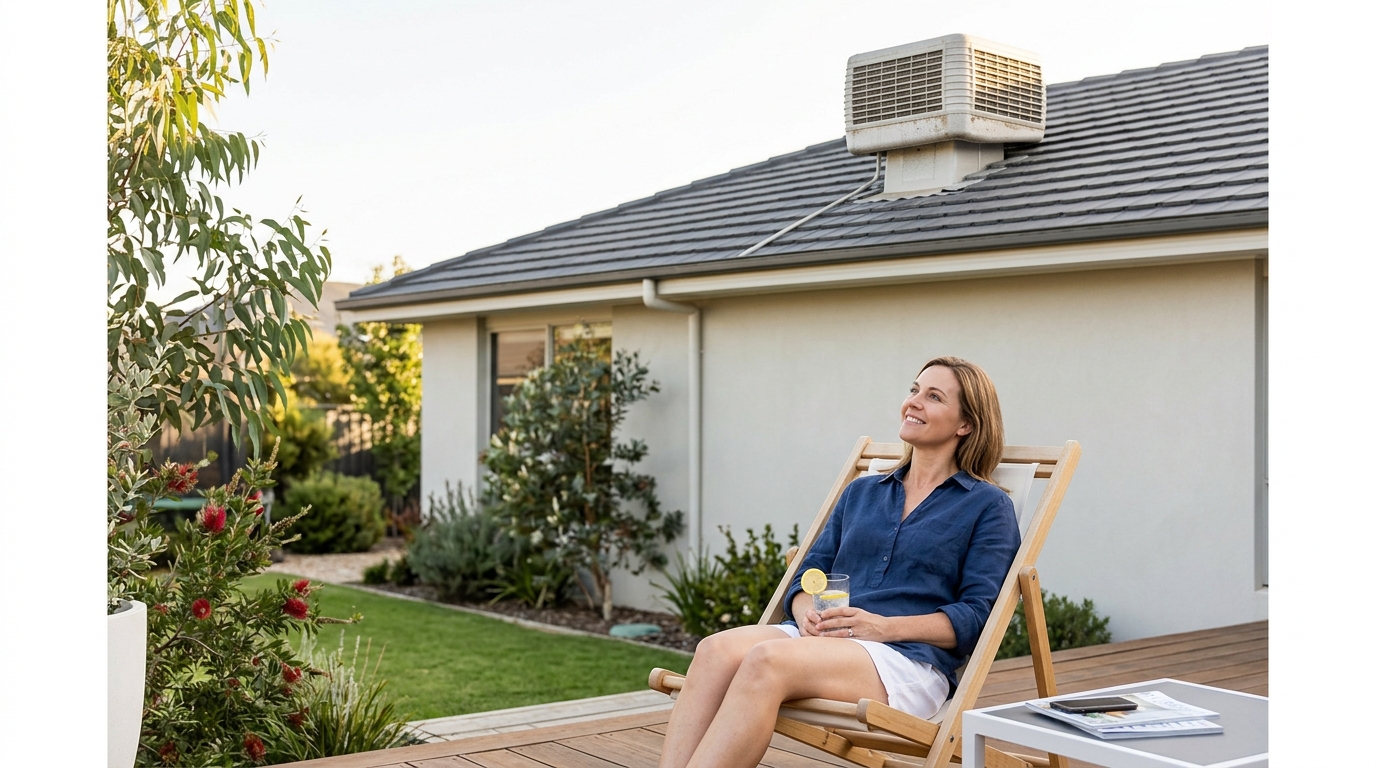
Think about the last time you stood near the ocean on a hot day, pressed a cool wet towel to your neck, or felt a breeze skim across a backyard pool. That instant relief is not just in your head. Evaporative air conditioning harnesses exactly that natural process to cool your home, drawing warm outside air through water-saturated pads to deliver a fresh, cooled airflow indoors. This article covers the science behind evaporative cooling, how the hardware works, when it performs at its best, its real limitations and how it stacks up against refrigerated split systems.
Key takeaways
- Evaporative air conditioners work by drawing hot air through water-saturated pads, using natural evaporation to cool incoming air by 10 to 15 degrees Celsius.
- Performance depends heavily on humidity. Evaporative cooling works best in dry climates like Perth and Adelaide, but struggles above 50 to 60 percent relative humidity.
- Running costs are very low, typically $0.05 to $0.15 per hour, making them energy-efficient for suitable climates.
- Refrigerated split systems are more reliable for humid coastal areas and offer heating capability that evaporative coolers cannot provide.
The Science Behind Evaporative Cooling
Evaporative cooling works because water absorbs heat energy from the air around it as it turns into vapour. That heat transfer lowers the temperature of the air passing through, producing a genuine cooling effect without a compressor or refrigerant. It is the same physics at work every time you step out of a swimming pool on a 35-degree afternoon and feel a sudden chill as the water on your skin begins to evaporate.
The technical measure that governs how much cooling is possible is called the 'wet-bulb temperature'. This is the lowest temperature air can reach through evaporation alone, and it is always lower than the actual air temperature when the air is dry. The bigger the gap between the actual air temperature (the 'dry-bulb' reading) and the wet-bulb temperature, the more cooling potential there is. In practical terms, this means dry air cools far more effectively than humid air.
In dry Australian climates such as inland Victoria, South Australia and Western Australia, evaporative cooling can drop the incoming air temperature by 10 to 15 degrees Celsius. On a 38-degree Perth afternoon with low humidity, that translates to genuinely comfortable indoor conditions. The technology is well-suited to these regions precisely because the physics work in their favour.
Why Humidity Is the Key Variable
Air can only absorb a limited amount of moisture at any given temperature. Once the air is already carrying a high moisture load, evaporation slows dramatically and the cooling effect diminishes. As a rough guide, once outdoor relative humidity climbs above 50 to 60 percent, an evaporative cooler starts to struggle. Above 70 percent, the temperature drop becomes marginal at best.
This is why evaporative coolers are a poor fit for coastal cities like Sydney, Brisbane and Darwin, where summer humidity regularly sits well above that threshold. On a humid 32-degree Sydney day, the air simply cannot absorb enough additional moisture to produce meaningful cooling, and the result is a home that feels warm and sticky rather than refreshed.
Contrast that with Perth or Adelaide, where summer days are frequently hot and dry. Relative humidity in these cities can sit below 20 percent on peak summer afternoons, giving evaporative systems plenty of room to work. Inland regions of New South Wales and Victoria tell a similar story. If you live in one of these drier climate zones, evaporative cooling is a genuinely effective and energy-efficient option. If you are on the coast, refrigerated cooling is almost always the better choice.
What's Inside an Evaporative Cooler: The Key Components
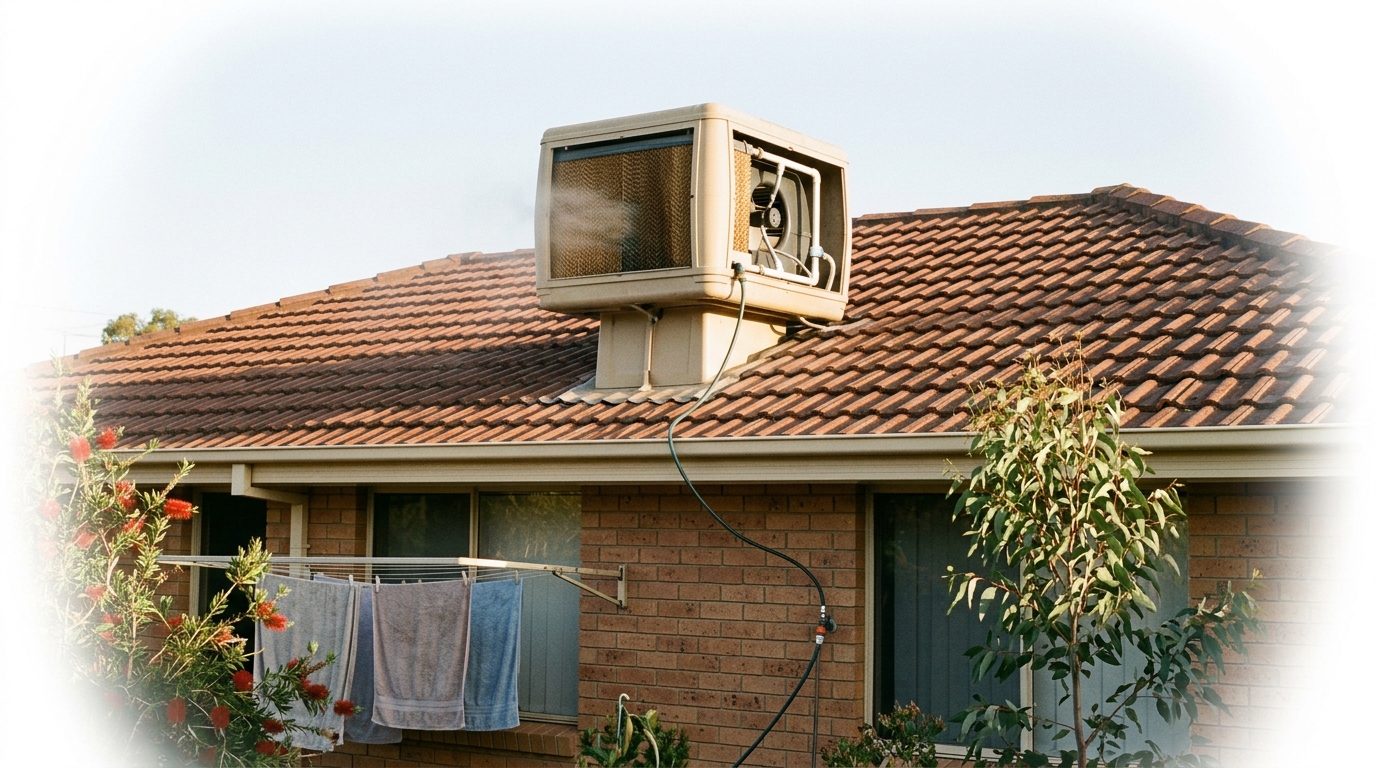
A ducted rooftop evaporative cooler has five core components that work together to pull hot outside air in, cool it down and push it through your home. Understanding each part makes it much easier to troubleshoot problems, plan maintenance and set realistic expectations for performance.
- Water reservoir and float valve. A built-in tank sits at the base of the unit and holds the water supply. A float valve, similar to the mechanism inside a toilet cistern, automatically maintains the correct water level and tops the reservoir up from your mains supply as water evaporates.
- Water pump. A small electric pump continuously circulates water from the reservoir up through a distribution system, feeding it evenly across the top of the cooling pads so they stay thoroughly saturated during operation.
- Cooling pads (also called filter pads or quilts). These are the heart of the system. Made from cellulose or synthetic fibre, the pads absorb and hold water across a large surface area. As hot outside air is drawn through the saturated pads, evaporation occurs and the air temperature drops before it enters the duct network.
- Fan and blower. A large centrifugal fan draws hot outside air through the wet pads and pushes the cooled air into the duct system. Fan speed is adjustable, giving you control over airflow volume and, to a degree, the intensity of cooling.
- Duct network and ceiling vents. Insulated ducts carry the cooled air from the rooftop unit down through the ceiling cavity and out through vents in each room, distributing fresh air across the whole home.
One critical operating requirement sets evaporative cooling apart from refrigerated systems. You must leave windows or doors slightly open while the unit runs. The fan is constantly pushing fresh air into the home, so warm air needs a path to escape. A refrigerated system recirculates sealed indoor air, so you keep everything closed. With evaporative cooling, open vents are not a flaw in the design but a fundamental part of how it works.
Ducted vs Direct (Portable) Evaporative Coolers
Ducted rooftop evaporative systems are the most common setup in Australian homes, particularly across South Australia, Western Australia and inland Victoria. They connect directly to your mains water supply for automatic refilling and distribute cooled air through the entire house via ceiling vents. Installation requires a licensed tradesperson and involves mounting the unit on the roof and running ductwork through the ceiling cavity.
Direct or portable evaporative coolers are a simpler, lower-cost alternative. These freestanding units sit on the floor, plug into a standard power point and require no installation at all. The trade-off is significant. They cool only the room they are placed in, and you need to manually refill their water tank every few hours. They suit renters or anyone who needs occasional spot cooling in a single room. If you need a portable refrigerated option instead, the Rinnai 2.6kW Portable (RPC26MC) from $689 is worth considering as a cooling-only unit that does not rely on humidity levels to perform.
Evaporative Cooling vs Refrigerated Split Systems: Which Is Right for You?
Evaporative cooling and refrigerated split systems both cool your home, but they do it in fundamentally different ways and suit very different situations. The right choice depends on your climate, budget, whether you need heating and how much you want to spend on running costs over time.
| Factor | Evaporative Cooling | Refrigerated Split System |
|---|---|---|
| Upfront Cost | $600 to $2,000 installed (ducted) | $989 to $3,500+ installed |
| Running Cost | Very low. Typically $0.05 to $0.15 per hour | Moderate. Typically $0.20 to $0.50 per hour |
| Humidity Performance | Poor above 50 to 60% relative humidity | Unaffected by humidity. Works in any conditions |
| Heating Capability | None | Yes. Most reverse-cycle models heat and cool |
| Installation Complexity | Moderate. Rooftop unit plus ductwork | Straightforward. Indoor and outdoor unit, refrigerant line |
| Best Climate | Hot and dry. Perth, Adelaide, inland NSW and VIC | Any climate. Essential for coastal and humid regions |
The table tells a clear story. Evaporative cooling wins on running costs and is a strong performer in dry climates, but it has two hard limits. It cannot heat your home and it loses effectiveness as humidity rises. A refrigerated split system costs more to run but works reliably year-round regardless of the weather outside, and a reverse-cycle model handles both heating and cooling from a single unit.
If you are in a dry climate zone and only need summer cooling, an evaporative system is hard to beat on value. If you live on the coast, experience humid summers or want a single system that covers all seasons, split system air conditioners are the more practical choice. Air Conditioning Experts stocks a wide range from leading brands including Daikin, Mitsubishi Electric and Fujitsu. An accessible entry point is the Daikin 2.5kW Lite (FTXF25WVMA) from $989, which suits bedrooms and smaller living areas. For larger rooms, the Daikin 5kW Lite (FTXF50WVMA) from $1,589 offers more capacity without a significant jump in complexity.
Pros and Cons of Evaporative Air Conditioning
Evaporative air conditioning offers genuine advantages over refrigerated systems in the right conditions, but it also comes with real limitations that can make it the wrong choice for many Australian homes. Here is an honest look at both sides before you commit to a system.
The Advantages
- Lower purchase and installation cost. A ducted evaporative system typically costs $600 to $2,000 installed, which is considerably less than most refrigerated ducted systems. Even a quality portable evaporative unit can be picked up for a few hundred dollars.
- Very low running costs. Because there is no compressor, an evaporative cooler runs on just a fan motor and a small water pump. Running costs typically sit between $0.05 and $0.15 per hour, a fraction of what a refrigerated system draws.
- Adds moisture to dry air. In arid climates where indoor air can become uncomfortably dry, the gentle humidity an evaporative cooler introduces can actually feel pleasant and may reduce irritation for people with dry skin or respiratory sensitivities.
- Constant fresh air circulation. Unlike a refrigerated system that recirculates the same indoor air, an evaporative cooler continuously draws fresh outside air through the unit. This means the air inside your home is constantly being replaced rather than recycled.
- Lower environmental impact. No refrigerant, lower electricity draw and a simpler mechanical design all contribute to a smaller carbon footprint compared to refrigerated alternatives.
The Disadvantages
- Ineffective in humid conditions. This is the biggest limitation. Once outdoor humidity climbs above 50 to 60 percent, performance drops sharply. Homeowners in coastal cities like Sydney, Brisbane or Darwin will find an evaporative cooler largely useless on the hottest, most humid days. Those in humid climates are almost always better served by Daikin split systems or another refrigerated option that works regardless of the weather outside.
- No heating function. Evaporative coolers are cooling-only devices. You will need a separate heating solution for winter, which adds cost and complexity.
- Requires open windows. Leaving windows or doors ajar is essential for the system to work, but it also means dust, pollen, outside noise and insects can enter the home. This is a real trade-off for allergy sufferers or anyone living near a busy road.
- Regular maintenance is non-negotiable. Cooling pads need to be cleaned or replaced each season, the water reservoir requires descaling to prevent mineral build-up and the pump and distribution system need periodic checks. Neglect the maintenance and performance drops quickly.
- Significant water consumption. A ducted evaporative system can use 25 to 60 litres of water per hour during peak operation. In a long, hot summer this adds up, and in areas with water restrictions or high water costs it is worth factoring into your running cost calculations.
Is Evaporative Cooling Right for Your Home?
Evaporative cooling is a cost-effective, energy-efficient choice for Australian homes in dry climates, but it has hard limits that make it the wrong fit for a significant portion of the country. If you live in Perth, Adelaide, inland New South Wales or inland Victoria and only need summer cooling, an evaporative system offers excellent value and very low running costs. If you live in a humid coastal area, experience muggy summers or want a single system that handles both heating and cooling year-round, a refrigerated split system is the more practical and reliable solution.
For those ready to explore refrigerated options, the Daikin 2.5kW Lite (FTXF25WVMA) from $989 is an accessible entry point for bedrooms and smaller rooms, while the Daikin 5kW Lite (FTXF50WVMA) from $1,589 suits larger living areas. Browse the full range of Daikin split systems to compare models and capacities. If you are renting or not ready to commit to a fixed installation, portable air conditioners are a no-fuss alternative. The Rinnai 2.6kW Portable (RPC26MC) from $689 is a solid cooling-only option that performs regardless of outdoor humidity levels.
Frequently Asked Questions
How does an evaporative air conditioner work?
An evaporative air conditioner works by drawing hot outside air through water-saturated cooling pads. As the air passes through the wet pads, water evaporates and absorbs heat from the air, lowering its temperature by up to 10 to 15 degrees Celsius before a fan pushes the cooled air through your home via ducts and ceiling vents.
Can you use an evaporative cooler in humid weather?
Evaporative coolers perform poorly in humid conditions because air that is already carrying a high moisture load cannot absorb much additional water vapour, which is what produces the cooling effect. Once outdoor relative humidity climbs above 50 to 60 percent, the temperature drop becomes minimal. In coastal cities like Sydney, Brisbane and Darwin, where summer humidity regularly exceeds this threshold, a refrigerated system is a far more reliable choice.
Do evaporative coolers use a lot of water?
Yes, water consumption is a genuine consideration. A ducted rooftop evaporative system can use between 25 and 60 litres of water per hour during peak operation. Over a long, hot summer this adds up considerably, so it is worth factoring water costs and any local water restrictions into your decision before purchasing.
What is the difference between evaporative cooling and a split system?
Evaporative cooling uses water evaporation to cool incoming fresh air and works best in hot, dry climates. A refrigerated split system uses a compressor and refrigerant to cool recirculated indoor air and works reliably in any climate regardless of humidity. Split systems also offer reverse-cycle heating, which evaporative coolers cannot provide.
If you have decided that evaporative cooling is not the right fit for your home, browse our full range of split systems to find a refrigerated option that suits your climate, room size and budget.
Need expert advice?
Our team can help you choose the right air conditioning system for your space.