
How to Clean Your Split System Filter: A Step-by-Step Guide

Why Cleaning Your Split System Filter Matters
If your split system air conditioner is not cooling as well as it used to, or your power bills have crept up without explanation, a clogged filter is often the culprit. Knowing how to clean a split system filter is one of the simplest things you can do to keep your unit running efficiently, extend its lifespan and maintain healthy air quality in your home. It takes less than 30 minutes and costs nothing.
The filter sits behind the front panel of your indoor unit and acts as the first line of defence against dust, pet hair, pollen and other airborne particles. Every cubic metre of air that passes through your system gets screened by that filter before it circulates back into the room. Over time, the filter becomes coated in debris and airflow drops significantly.
A restricted filter forces the compressor and fan to work harder to push air through, which draws more electricity and generates extra heat inside the unit. Left unchecked, this strain accelerates wear on internal components and can lead to costly repairs or premature failure.
Key takeaways
- Learning how to clean split system filters takes 30 minutes and costs nothing.
- Regular maintenance prevents reduced airflow and higher energy bills.
- Clean filters every four to six weeks during heavy use periods.
This guide walks you through six straightforward steps: removing the filter safely, inspecting it for damage, vacuuming off loose debris, washing it with mild detergent, drying it thoroughly and refitting it correctly. Follow these steps every few weeks and your system will thank you for it.
What You'll Need Before You Start
Cleaning a split system filter requires no specialist tools and no chemicals you would not already have at home. Gather everything listed below before you begin so you are not hunting around mid-task with a wet filter in your hands.
- Vacuum cleaner with a brush attachment or a soft-bristle brush for removing loose dust without damaging the filter mesh
- Mild dish detergent mixed with warm water in a bucket or sink, enough to submerge or rinse the filter
- Warm water from a tap at low pressure, or a gentle shower head setting if you are rinsing in the bathroom
- A clean dry cloth or towel to blot excess moisture after washing
- A flat, clean surface such as a bench or table covered with an old towel, to lay the filter on while it air-dries
- A step stool or ladder if your indoor unit is mounted high on the wall
That is genuinely all you need. No commercial cleaning sprays, no compressed air canisters and no professional equipment. This is a straightforward DIY task that any homeowner can handle safely, as long as the unit is switched off at the wall before you start.
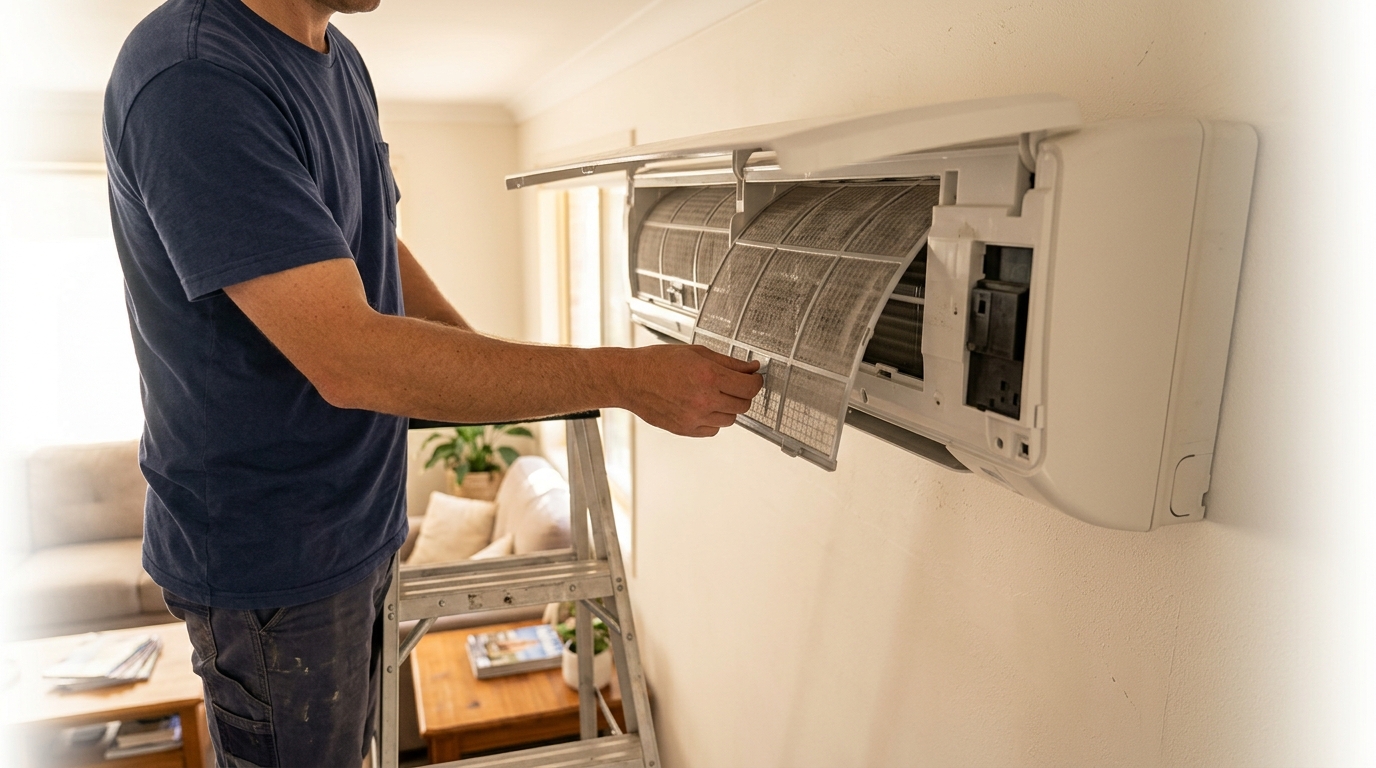
How to Clean Your Split System Filter: 6 Simple Steps
To clean a split system filter, turn the unit off, open the front panel, slide out the filters, vacuum off loose dust, wash them under warm running water with mild detergent, then allow them to air dry completely before refitting. The whole process takes around 20 to 30 minutes and requires no specialist tools or chemicals.
- Turn off and unplug the unit. Switch the air conditioner off using the remote or wall controller, then turn it off at the wall switch or isolator. If your unit is plugged into a standard power point, unplug it entirely. Never work on the unit while it is powered on, even if it appears to be in standby mode.
- Open the front panel. Most wall-mounted split systems have a hinged front panel that lifts upward from the bottom edge. Grip both lower corners of the panel and lift gently until it clicks into its open position. Some models use small side latches that you press inward before lifting. The panel should stay propped open on its own once fully raised.
- Remove the filters carefully. The filters sit in a frame or slot just inside the front panel and typically slide or lift out with light pressure. Take note of which way they are oriented before you remove them, as they need to go back in the same direction. Most filters are labelled or have a visible 'top' edge to make this straightforward.
- Vacuum loose dust from both sides. Use a vacuum cleaner with a soft brush attachment to remove the bulk of the dust before introducing any water. Work gently across the surface in one direction rather than scrubbing back and forth, which can push debris deeper into the mesh. Vacuum both the front and back of each filter.
- Wash the filters under warm running water. Hold each filter under a tap at low pressure and rinse from the clean side through to the dirty side to push debris out rather than in. Add a small amount of mild dish detergent and work it in gently with your fingers if the filter is particularly grimy. Rinse thoroughly until the water running off the filter is completely clear.
- Air dry completely before reinserting. Lay the filters flat or prop them upright in a shaded spot with good airflow and allow them to dry naturally. This typically takes one to two hours depending on conditions. Never use a hair dryer, direct sunlight or any heat source to speed up drying, as heat can warp or damage the filter mesh.
Before you refit the filters, take a moment to wipe down the inside of the front panel with a lightly damp cloth to remove any dust that has settled on the plastic housing. Once the filters are fully dry, slide them back into their slots in the correct orientation, lower the front panel until it clicks shut and restore power to the unit.
Most major brands follow this same general process. Popular entry-level models like the Daikin LITE FTXF25WVMA ($989) and the Mitsubishi Electric MSZ-AP25VGKD ($1,122) both use a standard hinged panel and slide-out filter design that matches these six steps closely. Daikin split systems across the range are particularly straightforward to service at home. That said, always check your unit's manual for any model-specific guidance, as some units have additional filter layers or locking mechanisms that differ from the standard setup.
How Often Should You Clean Your Split System Filter?
You should clean your split system filter every four to six weeks during periods of heavy use, such as the peak of summer or winter, and at least once every three months during milder seasons when the unit runs less frequently. Sticking to this schedule keeps airflow strong, energy consumption low and air quality healthy throughout the year.
Some households will need to clean more often than this general guide suggests. If you have pets that shed fur, live in a dusty environment such as near a construction site or unsealed road, or have family members with allergies or asthma, a fortnightly clean during heavy-use periods is a sensible precaution. Dust and pet dander accumulate faster than most people expect, and a filter that looks fine from the outside can already be restricting airflow significantly.
The good news is that many modern units take the guesswork out of scheduling entirely. The Fujitsu ASTG09KMTC ($1,018), for example, features a built-in filter indicator light that illuminates when the system detects it is time for a clean, based on actual runtime hours rather than a fixed calendar interval. Daikin and Mitsubishi Electric models across their mid-range and premium lines offer similar reminder functions. Check your remote control display or the unit's front panel for a filter icon or indicator light.
It is worth being clear about the difference between DIY filter cleaning and professional servicing. Cleaning the filters yourself is something any homeowner can and should do regularly. Professional servicing is a separate task that should be carried out by a licensed technician once a year. A professional service covers things you cannot safely do yourself, including deep cleaning the evaporator coil, checking refrigerant levels, inspecting electrical connections and clearing the condensate drain line. Think of filter cleaning as the routine maintenance you do yourself, and annual servicing as the equivalent of a mechanic's inspection.
Signs Your Filter Needs Attention Right Now
The most common signs that a split system filter is overdue for cleaning are reduced airflow from the indoor unit, longer run times to reach the set temperature, musty or stale odours when the system starts up, visible dust or grey discolouration on the filter mesh and a louder-than-normal operating sound. Any one of these is a clear prompt to pull the filter out and give it a wash.
Reduced airflow is usually the first thing people notice. If you hold your hand near the vents and the air feels weak or barely moving, a clogged filter is the most likely cause. Similarly, if your unit is running for much longer than it used to before the room reaches the temperature you have set, the restricted airflow is forcing the system to work overtime to compensate.
Musty or stale smells are a sign that dust, moisture and potentially mould have built up on the filter surface. This is particularly common in humid climates or in rooms that do not get much ventilation. A thorough wash usually clears the odour completely.
If you ignore these warning signs for too long, the consequences become more serious. Ice can form on the evaporator coil as airflow drops below the level needed to keep the coil temperature stable, and some units will shut themselves down on a high-pressure fault to prevent internal damage. The good news is that catching these signs early and cleaning the filter promptly almost always resolves the problem without any need for a technician.
Keep Your Split System Running at Its Best
Cleaning your split system filter is one of the quickest, easiest and most cost-effective things you can do as a homeowner. It takes under 30 minutes, costs nothing and makes a genuine difference to efficiency, air quality and the long-term health of your unit. A well-maintained filter protects the investment you have made in your system and helps it deliver reliable comfort for years to come.
If your current unit is ageing, struggling to keep up or simply due for an upgrade, now is a great time to explore what is available. You can browse our full range of split systems to compare models, capacities and brands, or get in touch with our team for honest advice on choosing the right system for your home and budget. We are here to help you make the right call.
Frequently Asked Questions
Can I clean my AC filter myself?
Cleaning a split system filter is a straightforward DIY task that requires no tools or technical knowledge. Simply remove the filter panel, vacuum off loose dust, rinse the filter under warm water, let it dry completely, then reinsert it. For deeper maintenance like coil cleaning and refrigerant checks, an annual professional service is still recommended.
How often should split system filters be cleaned?
Split system filters should be cleaned every four to six weeks during periods of heavy use, and at least every three months otherwise. Pet owners, allergy sufferers and those in dusty or high-pollen environments should clean more frequently. Many modern units include a filter indicator light that takes the guesswork out of knowing when it is time.
What are signs of a clogged AC filter?
The most common signs of a clogged AC filter are weak or reduced airflow, musty odours from the vents, the unit struggling to reach the set temperature, visible dust build-up on the filter mesh and increased running noise. In severe cases, a blocked filter can cause the evaporator coil to ice over or trigger a system fault code.
Will my AC work better if I clean the filter?
Yes, your AC will work noticeably better with a clean filter. A clean filter restores proper airflow, allowing the unit to reach the set temperature faster and run more efficiently, which translates directly to lower electricity bills and less wear on the compressor. Manufacturer guidelines consistently identify filter maintenance as the single biggest factor in maintaining unit performance between professional services.
Need expert advice?
Our team can help you choose the right air conditioning system for your space.