
What Is Aircon Regassing and Do You Actually Need It?
What Is Aircon Regassing and How Does It Work?
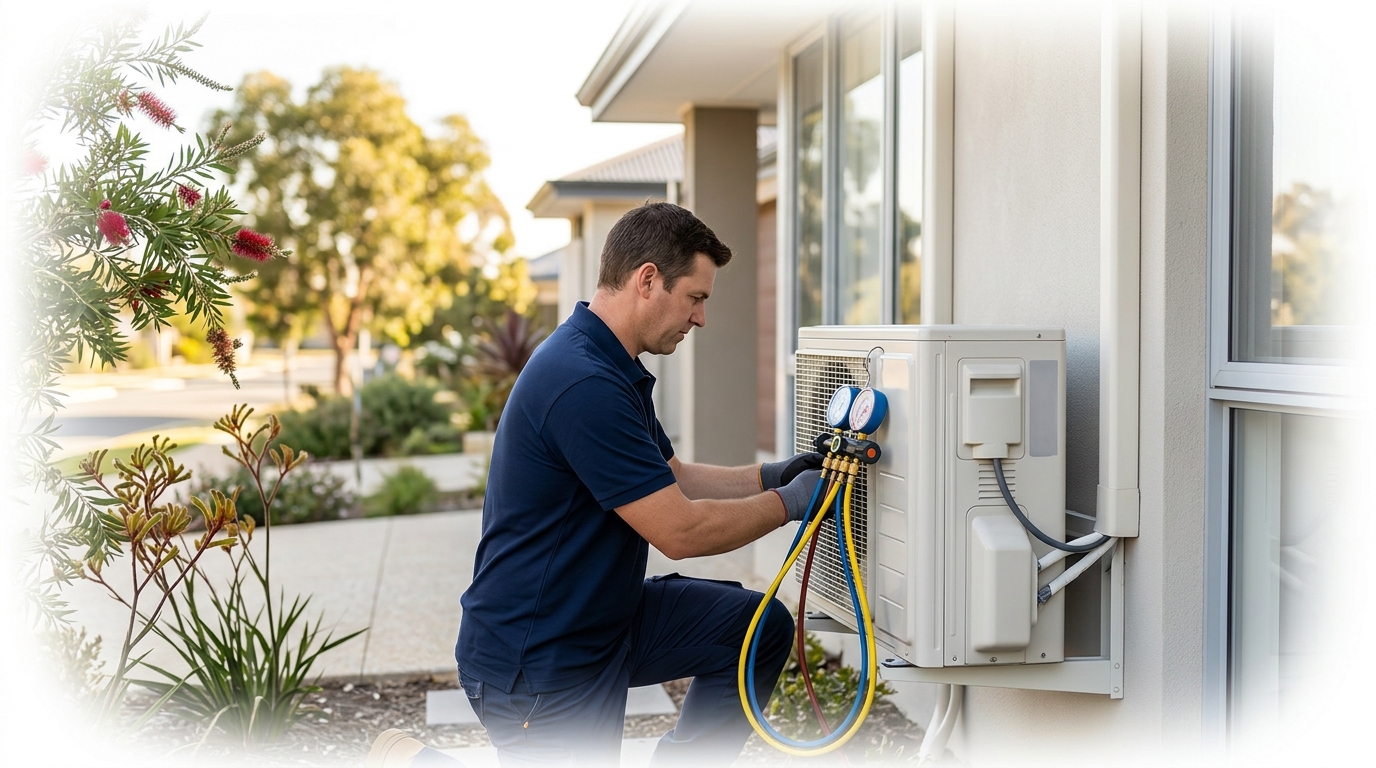
Aircon regassing means replenishing the refrigerant gas inside your air conditioning system. Refrigerant is the substance that absorbs heat from the air inside your home and releases it outside, which is how your system produces cool air. If you've been searching for how to regas an air conditioner, the short answer is that it's a job for a licensed refrigeration technician, not a DIY task. The good news is that a well-installed system on a modern home rarely needs it.
Refrigerant circulates in a closed loop between the indoor and outdoor units. It shifts between liquid and gas states as it moves through the system, picking up heat on one end and dumping it on the other. This cycle repeats continuously while your unit runs, and the refrigerant itself is never consumed in the process.
This article covers the warning signs that refrigerant levels may be low, why that happens, what a regas actually costs and how to decide whether a regas or a full replacement makes more financial sense for your situation.
Key takeaways
- How to regas an air conditioner is a job only licensed technicians can perform under Australian law.
- Low refrigerant always indicates a leak that must be found and repaired before regassing.
- Replacement often makes better financial sense than regassing for systems over 10 years old or running on R22.
Signs Your Air Conditioner May Need Regassing
Low refrigerant levels produce a recognisable set of symptoms, but none of them are exclusive to a regas problem. Each sign below can also point to a faulty compressor, a blocked filter or an electrical fault, so treat them as reasons to call a technician rather than a definitive diagnosis.
- Blowing warm or lukewarm air. If your system is running but the air coming from the vents feels barely cool, the refrigerant may not have enough pressure to absorb heat effectively. This is the most common complaint associated with low gas levels.
- Ice forming on the indoor unit or copper pipes. Counterintuitively, low refrigerant causes the evaporator coil to get too cold and freeze over. You may notice frost or ice on the indoor unit or along the copper lines running to the outdoor unit.
- Longer run times to reach the set temperature. A system low on refrigerant has to work harder and run longer to hit the temperature you've set. If your unit used to cool a room in 20 minutes and now takes an hour, that's worth investigating.
- Hissing or bubbling sounds near the unit. These noises can indicate refrigerant escaping through a crack or loose fitting. A hissing sound near the indoor or outdoor unit is a strong reason to switch the system off and call a technician promptly.
- Noticeably higher electricity bills. A system struggling with low refrigerant draws more power to compensate. If your bills have climbed without any change in how often you use the unit, reduced system efficiency is a likely cause.
If you notice one or more of these signs, resist the urge to simply book a regas. A technician needs to pressure-test the system first to confirm refrigerant is actually the issue and to check for any underlying fault.
Why Refrigerant Levels Drop in the First Place
Air conditioners are sealed systems. Refrigerant does not get used up or burn off the way fuel does in an engine. If the level is low, gas has escaped somewhere, and that almost always means there is a leak.
The most common causes of refrigerant leaks are corrosion on the copper pipework, vibration damage to fittings over years of operation, poor workmanship during the original installation and general wear on older units. Formicary corrosion, a type of pitting caused by a reaction between copper, moisture and certain household chemicals, is a particularly common culprit in Australian homes.
Topping up the refrigerant without locating and repairing the leak is a short-term fix at best. The gas will simply escape again, often within months, and you'll be paying for another regas on top of the original problem. Any reputable technician will find and fix the leak before recharging the system.
How to Regas an Air Conditioner: What the Process Actually Involves
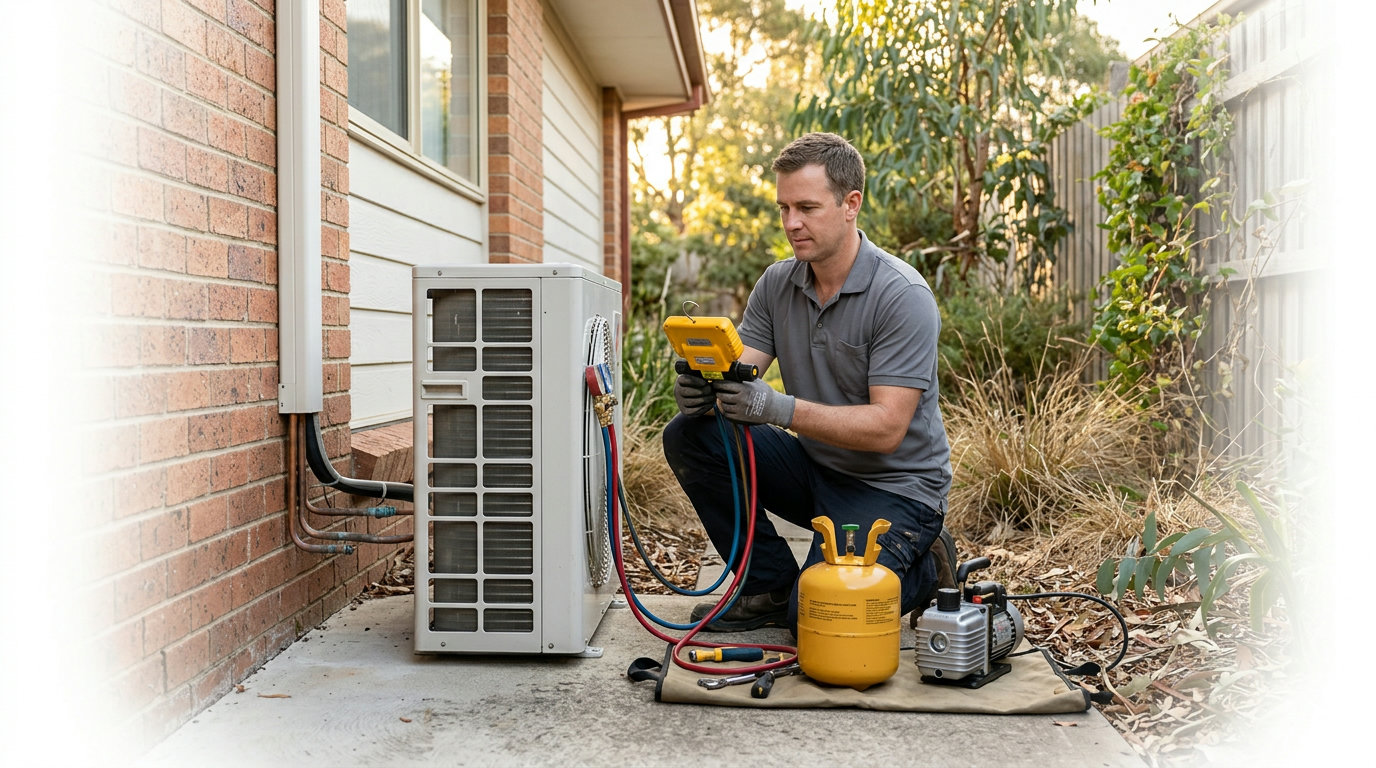
A professional aircon regas follows a strict sequence of steps that a licensed refrigeration technician carries out using certified equipment. The entire process typically takes one to three hours depending on the system size and whether a leak repair is needed. Under the Ozone Protection and Synthetic Greenhouse Gas Management Act, handling refrigerant in Australia without an ARCtick licence is illegal. This is not a job you can do yourself, and no reputable supplier will sell refrigerant to an unlicensed person.
- Inspect the system and check for visible damage or leaks. The technician starts with a visual inspection of the indoor unit, outdoor unit and copper pipework. They look for oil staining around fittings, corrosion on the coils and any obvious physical damage that might indicate where refrigerant has escaped.
- Connect manifold gauges to measure current refrigerant pressure. A set of manifold gauges is connected to the service ports on the outdoor unit. The readings tell the technician how much refrigerant is in the system and whether the pressures are consistent with a leak or another fault entirely.
- Locate and repair any confirmed leak before proceeding. If the pressure readings confirm a leak, the technician finds the exact location using an electronic leak detector or UV dye. The leak must be repaired at this point. Skipping this step and simply topping up the gas is poor practice and will leave you with the same problem within months.
- Recover any remaining refrigerant safely using certified equipment. Refrigerant cannot be vented to atmosphere. A recovery machine captures whatever gas remains in the system so it can be reclaimed or disposed of correctly under Australian environmental regulations.
- Vacuum the system to remove moisture and air. A vacuum pump is connected to pull the system down to a deep vacuum. This removes any air or moisture that entered during the repair process. Moisture left inside the system can cause acid formation and damage the compressor over time.
- Recharge with the correct refrigerant type and quantity. The technician charges the system with the exact refrigerant type and weight specified on the manufacturer's data plate. Using the wrong type or the wrong quantity will cause the system to underperform or fail prematurely.
- Test system operation and verify pressures are within spec. With the recharge complete, the technician runs the system and checks the operating pressures, temperature differential across the indoor coil and overall performance to confirm everything is working correctly.
Which Refrigerant Type Does Your System Use?
The refrigerant type your system uses depends largely on when it was installed. There are three types you're likely to encounter in Australian homes, and knowing which one you have affects both the cost and the practicality of a regas.
- R22 was the standard refrigerant in systems installed before roughly 2010. Australia phased out R22 production years ago, so any remaining stock is imported, expensive and increasingly scarce. If your system runs on R22, a regas will cost significantly more than a modern system, and that cost is likely to keep rising. For most R22 units, replacement is the more sensible financial decision.
- R410A became the dominant refrigerant in systems installed between approximately 2010 and 2022. It's still widely available and reasonably priced, making a regas on an R410A system straightforward if the unit is otherwise in good condition.
- R32 is the current standard in most new split system air conditioners sold in Australia today. It has a lower global warming potential than R410A and is used in the majority of modern units from Daikin, Mitsubishi Electric, Fujitsu and other leading brands.
The quickest way to find out which refrigerant your system uses is to check the data plate on the outdoor unit. It will list the refrigerant type and the exact charge weight in grams, both of which your technician will need before starting any regas work.
How Much Does Aircon Regassing Cost in Australia?
A standard split system regas in Australia typically costs between $150 and $350, covering the technician's labour and the refrigerant itself. That figure rises considerably if a leak repair is also required, with leak repairs adding anywhere from $100 to $300 or more depending on where the leak is located and how accessible it is. A pinhole in an easy-to-reach fitting is a quick fix. A leak deep inside a wall cavity or within the indoor coil is a much bigger job.
Ducted systems hold a larger refrigerant charge than split systems, so both the labour time and the refrigerant cost are higher. Expect to pay $300 to $600 or more for a ducted system regas, again before any leak repair work is factored in. Call-out fees also vary by region and technician, and in regional or rural areas you may pay a premium on top of the standard service rate.
Before committing to a regas on an older unit, it's worth comparing the repair cost against the price of a new system. A brand-new Daikin 2.5kW Inverter Split System LITE (FTXF25WVMA) is priced at $989, and the Daikin 2.5kW Inverter Split System CORA (FTXV25WVMA) sits at $1,054. If your existing unit is more than 10 years old, already running on R22 and needs both a leak repair and a regas, you could easily be looking at $400 to $600 in service costs for a system that may need further attention within a few years. A new unit at that price point comes with a manufacturer's warranty, modern energy efficiency ratings and R32 refrigerant that won't be difficult or expensive to source. Browse our range of Daikin split systems to compare current models and pricing.
When Replacement Makes More Sense Than Regassing
Replacement is often the smarter financial decision when a regas quote arrives for an older or repeatedly faulty system. If the combined cost of a leak repair and regas exceeds 50% of what a comparable new unit would cost, you're better off putting that money toward a replacement. A new system comes with a manufacturer's warranty, modern energy efficiency ratings and a refrigerant that won't be scarce or expensive to source.
Four situations where replacement is worth serious consideration:
- The unit is more than 10 years old. Systems from that era were built to lower efficiency standards and are more likely to develop further faults after a regas. Parts availability also becomes an issue as units age past the decade mark.
- It runs on R22 refrigerant. As covered earlier, R22 is expensive and increasingly hard to source in Australia. A regas on an R22 system can cost two to three times more than the same job on a modern R32 unit, and that cost will only climb.
- The repair plus regas cost exceeds 50% of a new unit's price. This is the practical rule of thumb most technicians use. If you're spending $600 to $800 on a system that might need the same attention again in two years, the maths rarely stack up.
- The system has had repeated faults. One regas on an otherwise healthy unit is reasonable. If you're booking the technician for the second or third time in a few years, the system is telling you something.
Modern inverter split systems are significantly more energy-efficient than units installed 10 or more years ago. The running-cost savings from a high-efficiency replacement can offset a good portion of the upfront price within a few years, particularly in climates where the system runs hard through summer. The Daikin 5kW Inverter Split System CORA (FTXV50WVMA), priced at $1,697, is a practical mid-range example with strong energy ratings and R32 refrigerant. For many households replacing an ageing 5kW unit, the efficiency gains alone make that price point worth a close look. If you're weighing up your options, browse our full range of split system air conditioners to compare current models side by side.
Ready for a Reliable System? Browse Our Range
Aircon regassing is sometimes necessary, but it's never a fix you can do yourself and it's never the first step. A licensed refrigeration technician needs to diagnose the root cause before any refrigerant is touched. If there's a leak, it must be repaired before the system is recharged, otherwise you'll be back in the same position within months.
If your system is more than 10 years old, running on R22 or has needed repeated attention, replacement is often the more sensible investment. A new unit gives you a manufacturer's warranty, better energy efficiency and lower running costs from day one.
When you're ready to explore your options, take a look at our range of split system air conditioners or ducted air conditioners to find a system that suits your home and budget.
Frequently Asked Questions
How often does an air conditioner need regassing?
A properly installed air conditioner should never need regassing under normal circumstances. Refrigerant circulates in a sealed loop and is not consumed during operation. If your system needs a regas, it means there is a leak somewhere in the system that needs to be found and repaired first.
Can I regas my air conditioner myself?
No. Handling refrigerant in Australia without an ARCtick licence is illegal under the Ozone Protection and Synthetic Greenhouse Gas Management Act. Refrigerant cannot be purchased without a licence, and venting it to atmosphere carries significant penalties. This is strictly a job for a licensed refrigeration technician.
How long does an aircon regas take?
A straightforward regas on a split system typically takes one to three hours. If a leak needs to be located and repaired before the system is recharged, the job will take longer. Complex leaks in hard-to-access locations, such as inside a wall cavity or within the indoor coil, can extend the job considerably.
How do I know if my aircon needs regassing?
The most common signs are warm or lukewarm air from the vents, ice forming on the indoor unit or copper pipes, longer run times to reach the set temperature and unexplained increases in electricity bills. These symptoms can also point to other faults, so a technician should pressure-test the system before any refrigerant is added.
Is it worth regassing an old air conditioner?
It depends on the age of the unit, the refrigerant type and the total repair cost. As a general rule, if the combined cost of a leak repair and regas exceeds 50% of what a comparable new unit would cost, replacement is the better investment. Systems older than 10 years running on R22 refrigerant are rarely worth regassing given the high cost and scarcity of that refrigerant.
What refrigerant does my air conditioner use?
The refrigerant type is listed on the data plate attached to the outdoor unit, along with the exact charge weight in grams. Most systems installed before 2010 use R22, systems from roughly 2010 to 2022 typically use R410A, and most units sold today use R32. Your technician will need both the refrigerant type and charge weight before starting any regas work.
Need expert advice?
Our team can help you choose the right air conditioning system for your space.