
Toshiba Air Conditioner Troubleshooting: Common Problems and How to Fix Them
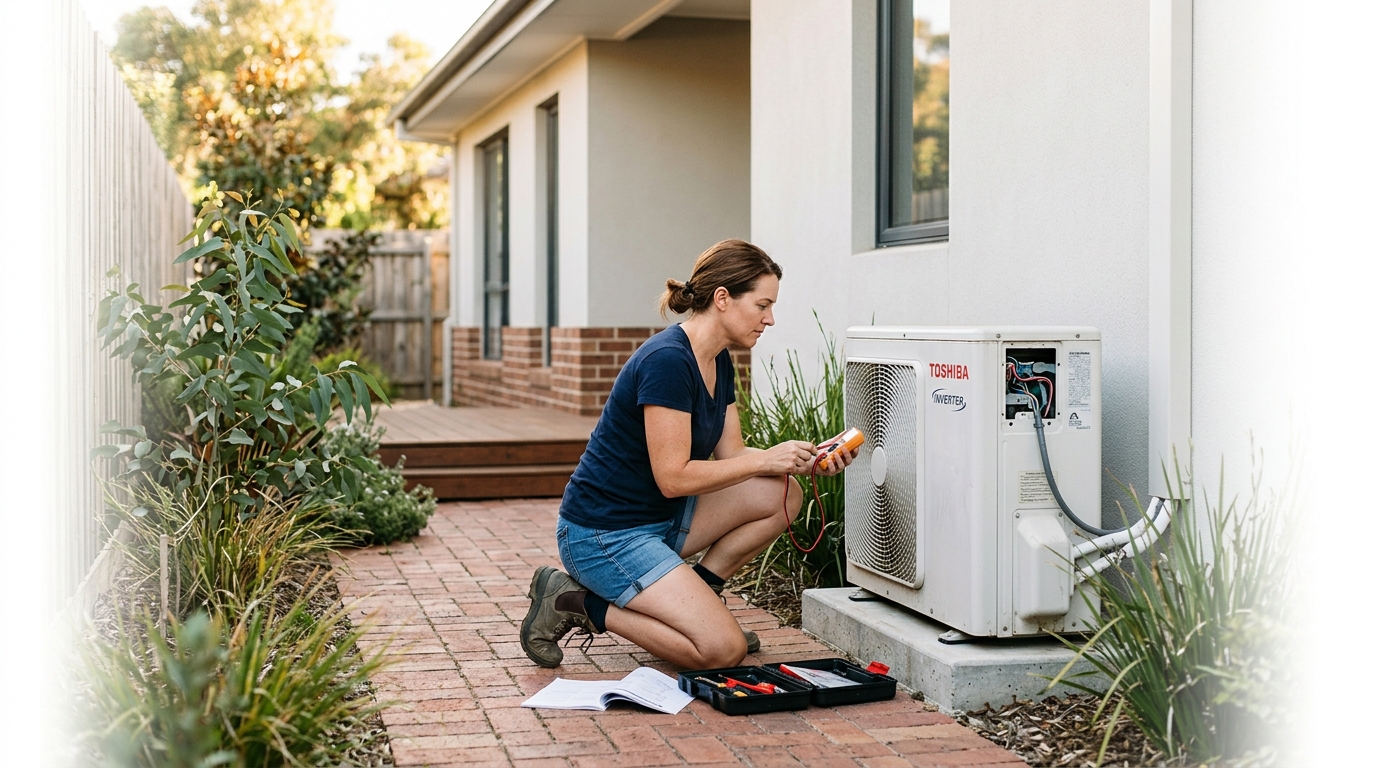
Toshiba Air Conditioner Troubleshooting: Where to Start
A Toshiba air conditioner that stops cooling, starts leaking or throws up a cryptic error code is genuinely frustrating, especially in the middle of an Australian summer. The good news is that Toshiba air conditioner troubleshooting covers a lot of ground you can handle yourself, without calling a technician. Dirty filters, incorrect remote settings and minor water leaks are all DIY-friendly fixes. This article walks through the four most common problem categories: no cold air, error codes and fault indicators, remote control issues and water leaks.
That said, not every fault is safe to tackle on your own. Refrigerant leaks and electrical faults must be handled by a licensed technician. Attempting either yourself is both dangerous and illegal under Australian law. Start with the simple checks first, and you may have your unit running again within the hour.
Key takeaways
- Toshiba air conditioner troubleshooting often starts with simple fixes like cleaning filters and checking remote settings.
- Refrigerant leaks and electrical faults require a licensed technician and are illegal to handle yourself.
- Most common faults involve blocked filters, incorrect settings, dirty condenser coils or water drainage issues.
Toshiba Air Conditioner Not Blowing Cold Air
A Toshiba split system that runs but fails to cool the room is one of the most common faults reported by Australian homeowners. In most cases, the cause is one of four things: a clogged air filter restricting airflow, the unit being set to the wrong mode or temperature, a blocked or dirty outdoor condenser coil, or a low refrigerant charge. The first three are straightforward to check yourself. The fourth requires a licensed professional.
Work through these causes in order of how easy they are to address:
- Dirty air filter. A blocked filter is the single most common cause of poor cooling. It starves the indoor unit of airflow and forces the system to work harder for less output.
- Incorrect mode or temperature setting. Check that the remote is set to 'Cool' mode, not 'Fan' or 'Dry', and that the set temperature is actually lower than the current room temperature.
- Blocked outdoor unit or dirty condenser coils. Walk outside and check that nothing is obstructing the outdoor unit. Leaves, debris and overgrown plants can all reduce airflow across the condenser coils. A gentle rinse with a garden hose (unit powered off) can clear surface grime.
- Low refrigerant charge. If the above checks come back clear, low refrigerant is likely. This requires a licensed technician to diagnose and repair.
How to Check and Clean Your Toshiba Filter
Toshiba recommends cleaning the air filter every four to six weeks during periods of heavy use. A clean filter restores airflow, improves cooling performance and reduces running costs. Here is how to do it on a wall-mounted Toshiba split system:
- Turn the unit off at the wall. Switch off the power at the wall switch or circuit breaker before touching any part of the unit. Never work on a live appliance.
- Open the front panel. Lift the front cover upward. It should hinge open and stay in place. On most Toshiba wall units, the filters sit just behind this panel in a slide-out frame.
- Slide out the filter. Grip the filter tab and pull it gently downward and out. Take note of which way it faces so you can reinsert it correctly.
- Rinse under lukewarm water. Hold the filter under a gentle stream of lukewarm water, rinsing from the clean side through to the dirty side. Do not use hot water, detergent or a pressure washer, as these can damage the mesh.
- Allow to dry fully, then reinsert. Shake off excess water and leave the filter to air dry completely in a shaded spot. Reinserting a wet filter can cause mould growth inside the unit. Once dry, slide it back in, close the front panel and restore power.
When Low Refrigerant Is the Cause
If cleaning the filter and checking the settings makes no difference, low refrigerant is worth considering. The tell-tale signs include ice forming on the indoor unit's coil or copper pipes, a faint hissing or bubbling sound near the indoor or outdoor unit, and the system running continuously without ever reaching the set temperature.
Under Australian law, refrigerant handling is restricted to technicians holding an ARCtick licence issued under the Refrigerant Handling Licence scheme. Purchasing, handling or venting refrigerant without this licence is illegal and carries significant fines. A licensed technician will locate and repair the leak before recharging the system. Simply topping up the refrigerant without fixing the underlying leak is only a short-term fix and the problem will return, often within weeks.
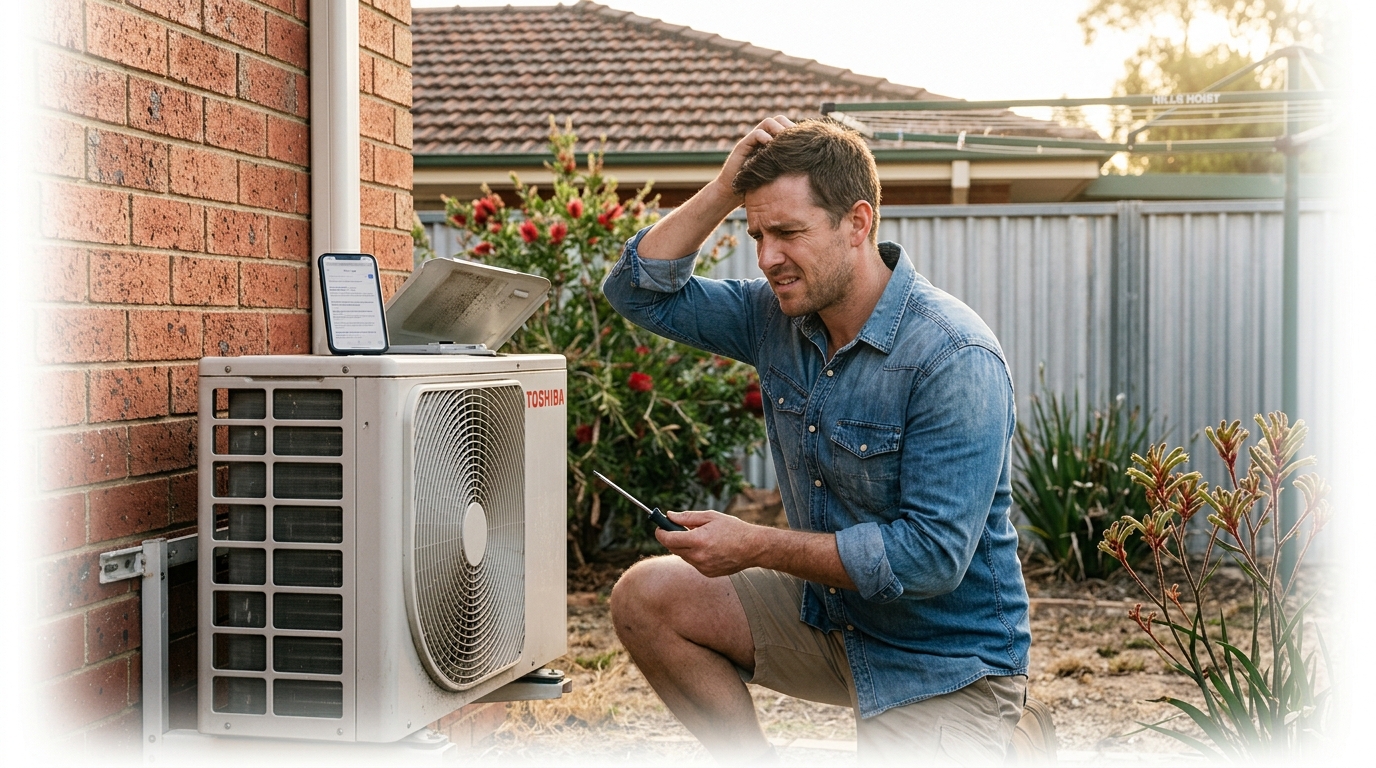
Understanding Toshiba Error Codes and Fault Indicators
Toshiba split systems communicate faults in two ways: alphanumeric error codes displayed on the remote control screen and flashing LED patterns on the indoor unit's operation light. Knowing what these codes mean lets you describe the fault accurately to a technician, which can cut diagnosis time significantly. Before you call anyone, note the exact code or count the number of flashes and write it down.
The table below covers the most common Toshiba error codes you are likely to encounter:
| Error Code | Meaning | Recommended Action |
|---|---|---|
| E01 | Indoor unit communication fault | Check that all wiring connections between the indoor and outdoor units are secure. If connections look intact, call a licensed technician. |
| E04 | Outdoor unit fault | Do not attempt to inspect the outdoor unit's internal components yourself. Call a licensed technician to diagnose. |
| F01 | Indoor temperature sensor fault | Check that the sensor is seated correctly and free of visible damage. If the code persists, call a technician for sensor replacement. |
| F03 | Outdoor temperature sensor fault | This is not a DIY repair. Call a licensed technician to inspect and replace the outdoor sensor. |
| P01 | High-pressure protection triggered | Check for blocked airflow around the indoor and outdoor units. Clear any obstructions, then reset the unit. If the code returns, call a technician. |
| Flashing operation light | Fault type indicated by number of flashes | Count the flashes carefully, then cross-reference with your model's manual. The flash count maps to a specific fault code unique to each model series. |
A few of these codes, particularly P01, can be triggered by something as simple as a blocked outdoor unit or a dirty filter restricting airflow. Always check the obvious causes first before assuming a major fault. For E01, E04, F01 and F03, the underlying cause is almost always a component or wiring issue that requires a technician regardless of what you find on a visual inspection.
One practical tip: take a photo of the error code on the remote display before you reset the unit. Technicians can diagnose faster when they know the exact code rather than working from memory.
Remote Control and Power Issues
A Toshiba air conditioner that will not respond to its remote or refuses to turn on at all is often caused by something straightforward: flat batteries, a tripped circuit breaker or a protective lockout after a power surge. These are among the easiest faults to resolve yourself, and working through a short checklist will tell you quickly whether the problem is in the remote, the unit or the power supply.
Remote Control Not Responding
Follow these steps in order before assuming the remote or the indoor unit is faulty:
- Replace the batteries with fresh cells. Most Toshiba remotes use AA or AAA batteries. Even batteries that show some charge in other devices may not supply enough current for reliable IR transmission. Use a new set.
- Clear any line-of-sight obstructions. The remote communicates via infrared, which requires a clear path to the receiver on the indoor unit. Furniture, curtains or a dusty receiver window can all block the signal.
- Point the remote directly at the receiver from within five metres. Toshiba remotes are rated for a range of around seven metres, but performance drops off at angles. Stand directly in front of the indoor unit and aim at the receiver panel.
- Perform a remote reset. Remove the batteries, hold the reset button (usually a small recessed button on the back of the remote) for three seconds, then reinsert the batteries. This clears any corrupted settings stored in the remote's memory.
- Test the indoor unit's manual on/off button. Every Toshiba wall unit has a manual button, usually located under the front panel or on the side of the unit. If the unit responds to the manual button but not the remote, the fault is in the remote itself. If it does not respond to either, the problem is with the unit or its power supply.
A damaged IR sensor on the indoor unit is less common but does occur, particularly on older units. If the manual button works but a brand-new remote still does not, the IR receiver on the unit likely needs replacing. At that point, weigh up the repair cost against the age of the system. Older Toshiba split systems with persistent remote faults and a history of other issues may be more cost-effective to replace than repair.
Unit Not Turning On at All
If the unit shows no signs of life at all, no display, no lights and no response to the manual button, check these three things before calling anyone:
- Tripped circuit breaker. Go to your switchboard and look for a tripped breaker in the air conditioning circuit. Reset it by switching it fully off and then back on. If it trips again immediately, stop and call an electrician.
- Blown fuse in the isolator switch. The outdoor isolator switch, mounted on the wall near the outdoor unit, contains a fuse that can blow during a power surge. Replacing this fuse is a job for a licensed electrician.
- Protective lockout after a power surge. Some Toshiba models enter a lockout mode after an unstable power event. Switching the unit off at the circuit breaker for 10 minutes, then restoring power, will clear the lockout on most models.
Water Leaking From Your Toshiba Air Conditioner
Water leaking from a Toshiba air conditioner is almost always caused by one of three things: a blocked condensate drain line, dirty evaporator coils producing excess condensation, or an indoor unit that was installed at the wrong angle. All three cause water to overflow the drain pan and drip into the room. The first two are DIY-friendly fixes. The third requires a licensed technician to re-bracket the unit.
Before you start, work out where the leak is coming from. A leak from the indoor unit, typically dripping from the front or bottom of the wall-mounted head, points to one of the three causes above. A small amount of water dripping from the outdoor unit during winter is normal. This is condensation produced during the defrost cycle, and it stops once the unit finishes defrosting. No action is needed.
If water is dripping onto electrical components, pooling near a power outlet or running down the wall toward your switchboard, turn the unit off at the circuit breaker immediately and call a technician. Do not run the unit again until the source of the leak has been identified and fixed.
For leaks from the indoor unit, work through these three causes:
- Blocked condensate drain line. This is the most common cause. The drain line carries condensation away from the indoor unit, and it can become blocked by mould, algae or debris over time. Locate the drain outlet, usually a small pipe exiting the wall near the indoor unit, and clear it using a wet/dry vacuum held over the outlet or a thin flexible brush pushed gently through the pipe. Once cleared, water should flow freely again.
- Dirty evaporator coils. A heavy build-up of dust and grime on the evaporator coils causes excess condensation that the drain pan cannot handle. Cleaning the coils with a coil cleaner spray (available at hardware stores) will reduce condensation back to normal levels. If the coils are heavily fouled, a professional service clean is the better option.
- Incorrect installation angle. The indoor unit must slope very slightly toward the drain outlet so gravity moves water in the right direction. If the unit was installed level or tilted the wrong way, water pools in the drain pan and overflows. This is not a DIY fix. A technician needs to re-bracket the unit at the correct angle.
Persistent or recurring leaks on a unit that is more than 10 years old can sometimes signal broader deterioration rather than a single fixable fault. If that sounds familiar, it may be worth browsing split system air conditioners to compare what a modern replacement would cost against ongoing repair bills.
When to Call a Professional and What to Do If Your Toshiba Is Beyond Repair
Knowing where the DIY boundary sits will save you time, money and the risk of making a fault worse. Filter cleaning, drain line clearing, battery replacement and basic power resets are all safe for homeowners to handle. Refrigerant handling, electrical faults, sensor replacements and any re-installation or re-bracketing work must go to a licensed technician. Attempting refrigerant work yourself is illegal under Australian law.
If your Toshiba unit is more than 10 years old and showing recurring faults, the repair bill can quickly exceed what the unit is worth. At that point, replacing it with a modern inverter system is often the smarter financial decision.
For a reliable like-for-like replacement at the 3.5kW capacity, three strong options are worth considering. The Daikin 3.5kW Cora Inverter Split System FTXV35WVMA is priced at $1,275. The Mitsubishi Electric 3.5kW AP Series MSZAP35VGKD comes in at $1,236. The Fujitsu 3.5kW Lifestyle Inverter Split System ASTG12KMTC is the most affordable of the three at $1,190. All three are well-regarded units with strong energy ratings and solid warranty support in Australia.
Browse the full range to find the right capacity and brand for your home.
Frequently Asked Questions
Why is my Toshiba air conditioner not cooling properly?
The most common reasons a Toshiba air conditioner stops cooling properly are a clogged air filter restricting airflow, the remote being set to 'Fan' or 'Dry' mode instead of 'Cool', a blocked outdoor unit or dirty condenser coils, or a low refrigerant charge. Start by cleaning the filter and checking the remote settings. If those checks come back clear, call a licensed technician to inspect the refrigerant level.
What do Toshiba air conditioner error codes mean?
Toshiba error codes are alphanumeric fault indicators displayed on the remote control screen. Common codes include E01 for an indoor-to-outdoor communication fault, F01 for an indoor temperature sensor fault and P01 for a high-pressure protection trigger. Note the exact code before resetting the unit, as this helps a technician diagnose the fault faster.
Why is my Toshiba air conditioner leaking water inside?
Water dripping from the indoor unit is almost always caused by a blocked condensate drain line, dirty evaporator coils producing excess condensation, or an indoor unit installed at the wrong angle. A blocked drain line is the most common culprit and can usually be cleared with a wet/dry vacuum. If the unit is tilted incorrectly, a licensed technician will need to re-bracket it.
How do I reset my Toshiba air conditioner?
To reset a Toshiba air conditioner, switch the unit off at the circuit breaker and leave it off for 10 minutes before restoring power. This clears any protective lockout triggered by a power surge or fault condition. If the unit displays an error code after the reset, note the code and contact a technician rather than continuing to reset the unit repeatedly.
Need expert advice?
Our team can help you choose the right air conditioning system for your space.