
Types of Air Conditioning Systems: Which One Is Right for Your Home?
Which Type of Air Conditioning System Do You Actually Need?
Walk into any appliance store or browse online and you'll quickly find yourself staring at a wall of options: split systems, ducted systems, multi-splits, portables, reverse-cycle, inverter. For most Australian homeowners, the sheer variety of types of air conditioning systems on the market makes choosing one feel harder than it should be. The good news is that the right choice usually comes down to a handful of practical factors specific to your home.
This article covers the four main system types: split system, ducted, multi-split and portable air conditioners. For each one, you'll get a clear picture of how it works, who it suits and what it actually costs. By the end, you'll have a straightforward framework for narrowing down the right option for your situation, your budget and your home's layout.
Key takeaways
- Split systems are the most popular type of air conditioning system for Australian homes due to lower cost and simple installation.
- Ducted systems provide whole-home coverage but require significantly higher upfront investment and installation complexity.
- Multi-split and portable options suit specific situations where split or ducted systems are impractical.
The Four Main Types of Air Conditioning Systems Explained
Most residential air conditioning in Australia falls into one of four categories. Split systems are wall-mounted units that condition a single room or zone. Ducted systems run through your roof cavity to cool or heat an entire home via ceiling vents. Multi-split systems connect multiple indoor units to a single outdoor compressor, giving you room-by-room control without full ductwork. Portable and window units require no permanent installation and suit renters or temporary setups.
Inverter technology, which varies the compressor speed to maintain a set temperature rather than cycling on and off, is now standard across split, ducted and multi-split systems from most major brands. This makes a real difference to running costs and comfort, regardless of which system type you choose.
Split System Air Conditioners
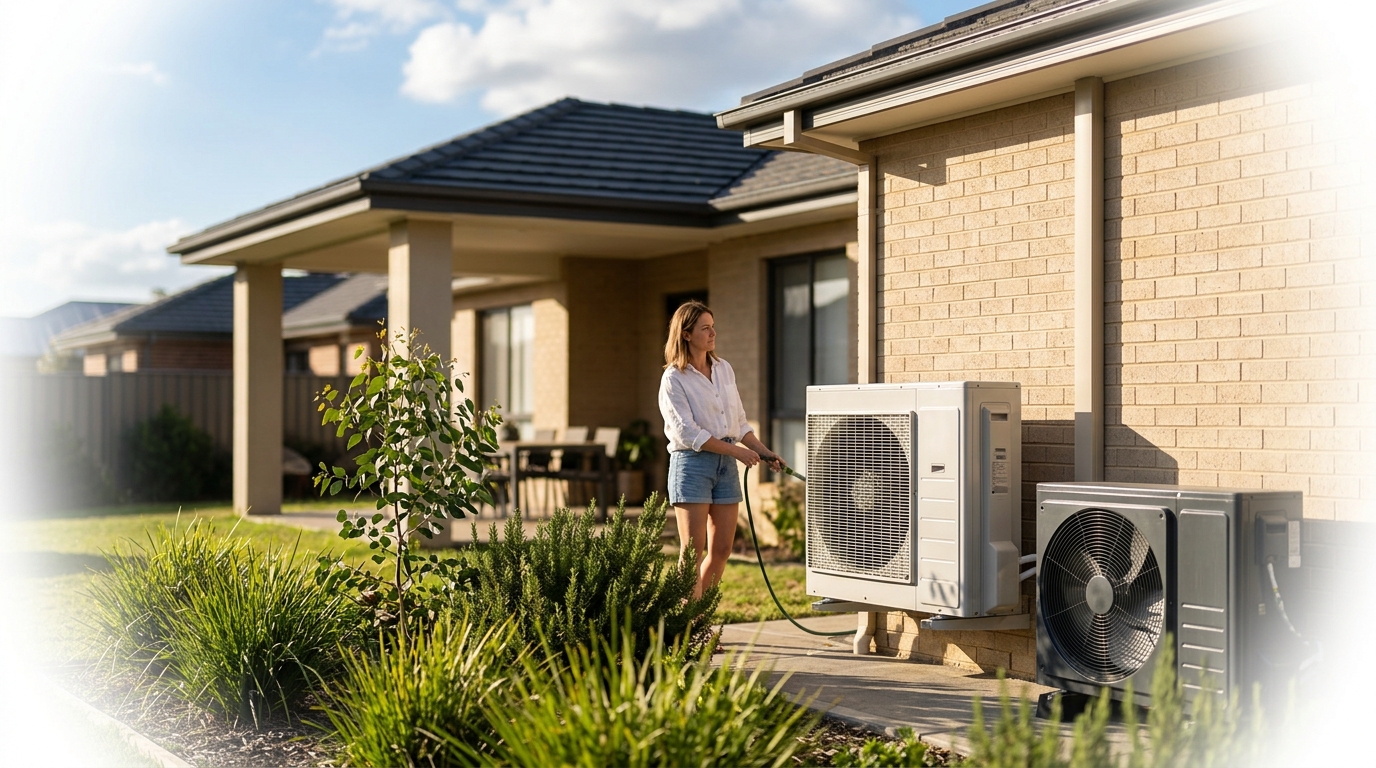
A reverse-cycle split system consists of one indoor wall-mounted unit connected to one outdoor compressor via refrigerant lines. The indoor unit draws in room air, passes it over a heat exchanger to cool or heat it, then circulates it back into the space. The outdoor unit handles the heat transfer with the outside air. Installation is relatively straightforward: an installer mounts the indoor unit on a wall, runs refrigerant lines through a small hole to the outdoor unit, and connects the electrics.
Split systems are the most popular choice for Australian homes, and for good reason. The upfront cost is lower than ducted, installation can usually be completed in a few hours, and you get precise control over individual rooms or zones. Modern units are also impressively quiet, particularly on lower fan speeds.
The honest trade-off is coverage. Each unit conditions one room or open-plan zone, so if you want whole-home comfort you'll need multiple units. The outdoor compressor also needs a suitable wall or ground space with adequate clearance, which can be a constraint on smaller blocks or apartments.
For sizing, a 2.5kW unit suits a small bedroom or study, while a 5kW to 7kW unit handles a larger living area. The Daikin 2.5kW Lite (FTXF25WVMA) at $989 is a solid entry-level option for a small bedroom or study. Step up to the Mitsubishi Electric 5kW AP Series (MSZ-AP50VGKD) at $1,653 for a larger living area. Both are inverter-driven and carry strong energy star ratings for Australian conditions.
Ducted Air Conditioning Systems
Ducted air conditioning uses a central unit, typically housed in the roof cavity or under the floor, connected to a network of insulated ducts that deliver conditioned air through ceiling or floor vents in each room. A single system can cover an entire home, with a controller on the wall managing temperature and, in zoned systems, which rooms are active at any given time.
The appeal is obvious: whole-home comfort from one system, with no visible indoor units cluttering your walls. Zoning lets you shut off rooms that aren't in use, which helps manage running costs. Aesthetically, ducted is the cleanest option available, with only small vent grilles visible in each room.
The trade-offs are real, though. Ducted systems carry a significantly higher upfront cost than split systems, and installation requires professional ductwork throughout the roof cavity, which adds time and labour. Retrofitting ductwork into an existing home is more complex and expensive than installing it during a new build. A Daikin 10kW Inverter Ducted system (FDYAN100) is priced from $4,017 for the unit alone, before installation, which gives you a realistic sense of the investment involved.
Ducted systems are best suited to larger homes, typically three or more bedrooms, where conditioning multiple rooms with individual split systems would cost a similar amount anyway. New builds are the ideal scenario, as ductwork can be planned into the construction from the start.
Multi-Split Systems
A multi-split system sits between a single split system and a full ducted setup. One outdoor compressor connects to multiple indoor units, typically two to five, each mounted in a different room and controlled independently. This means you can run the bedroom unit on a different temperature to the living room unit, all from a single outdoor compressor.
The appeal is flexibility. Multi-splits work well in homes where ducted is impractical, perhaps because the roof cavity is too shallow or the home is a renovation rather than a new build, but where a single split system won't cover enough of the house. You avoid running multiple outdoor units, which matters on smaller blocks.
The trade-offs are worth understanding before committing. Installation is more complex than a single split system, and the cost reflects that. If one component of the outdoor unit fails, all connected indoor units are affected. Not all brands offer the same multi-split range, so your choice of indoor unit styles may be more limited than with a standard split system. For most Australian homes, a multi-split is a practical middle-ground rather than the first choice.
Portable and Window Air Conditioners
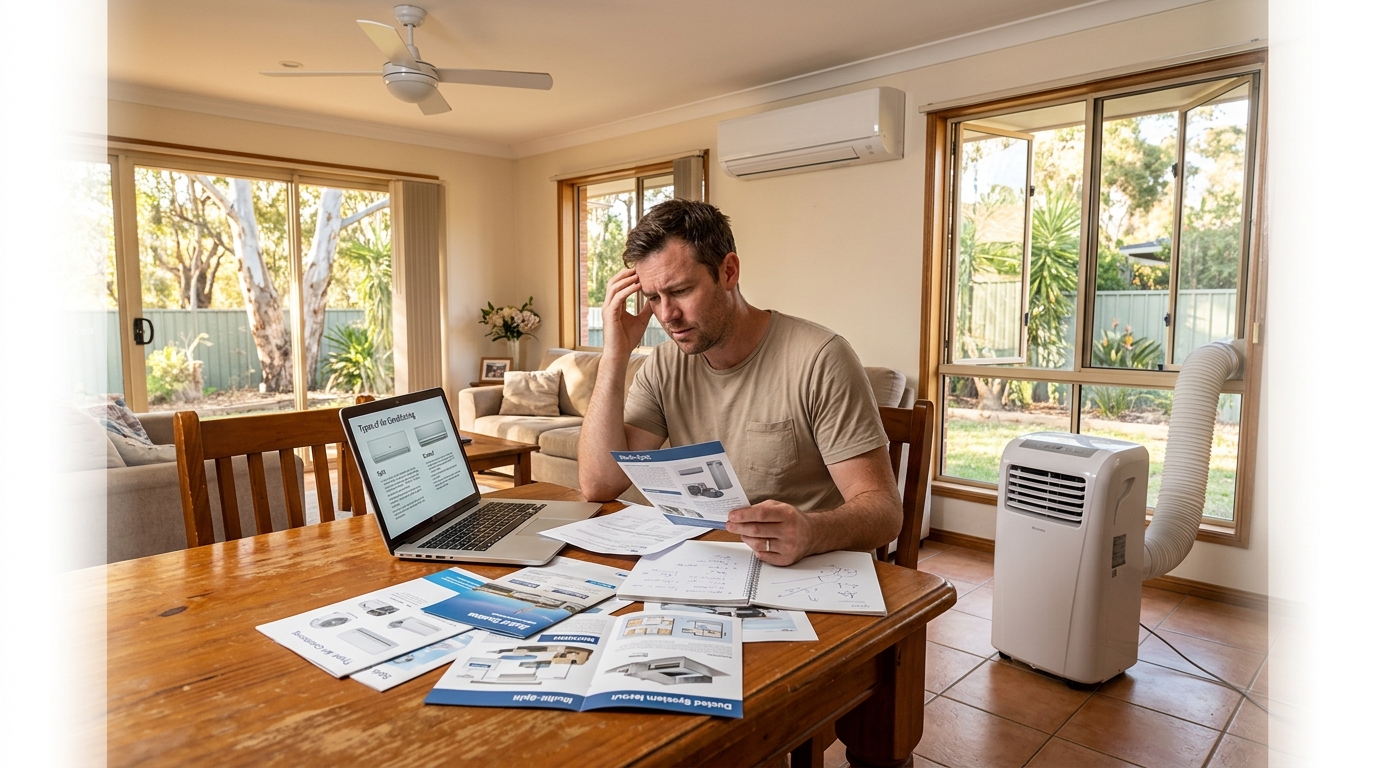
Portable air conditioners require no permanent installation, which makes them the go-to option for renters, temporary spaces or rooms where a split system isn't feasible. You plug the unit in, run a flexible exhaust hose out through a window or sliding door to vent hot air outside, and you're cooling. No tradesperson, no wall penetrations, no landlord approval needed.
The trade-offs are significant and worth being upfront about. Portable units are less energy-efficient than split systems of a comparable capacity, they generate more noise, and the window hose arrangement is not always convenient or airtight. They work best in small rooms and are better suited to short-term or occasional use than as a primary cooling solution for an Australian summer.
Window and wall units are a fixed alternative that doesn't require a separate outdoor compressor. They're more efficient than portables and sit permanently in a window or wall opening, but they do require a suitable aperture and some basic installation work. Browse our range of portable air conditioners for no-install options that suit renters and temporary setups.
Both portable and window units are best treated as a secondary or stopgap solution rather than a long-term replacement for a properly sized split or ducted system.
Comparing Air Conditioning System Types: A Side-by-Side Look
Choosing between a split system, ducted, multi-split or portable air conditioner comes down to four practical factors: what you need to cool, how much you want to spend upfront, how complex the installation is, and how efficient the system will be over time. The table below puts all four types side by side so you can see at a glance where each one fits.
| System Type | Best For | Upfront Cost Range | Installation Complexity | Energy Efficiency | Whole-Home Coverage |
|---|---|---|---|---|---|
| Split System | Single rooms or open-plan zones | $989 to $2,500+ (unit only) | Low. A few hours, one wall penetration | Excellent. Inverter-driven, high star ratings | No. One unit per room |
| Ducted | Whole-home comfort, larger homes | $4,000 to $12,000+ (unit only) | High. Roof cavity ductwork, multi-day install | Good. Zoning helps manage running costs | Yes. Entire home from one system |
| Multi-Split | Multiple rooms without full ductwork | $3,000 to $8,000+ (unit only) | Medium. Multiple indoor units, one outdoor | Very good. Inverter compressor shared across zones | Partial. Two to five rooms per system |
| Portable / Window | Renters, temporary setups, small rooms | $400 to $1,200 | Very low. No tradesperson required | Poor to moderate. Higher running costs per kW | No. Single room only |
The headline takeaway is straightforward. Split systems offer the best value for single rooms and are the most popular choice for Australian homes by a wide margin. Browse our full range of split system air conditioners to compare brands, capacities and price points, or explore our ducted air conditioners if whole-home coverage is the priority.
Multi-splits bridge the gap neatly for homes where ducted isn't practical but a single split system won't cover enough ground. Portable units are best treated as a short-term fix rather than a long-term solution. For most Australian homeowners buying their first or second system, a split system hits the sweet spot on upfront cost, running efficiency and installation simplicity.
How to Choose the Right Air Conditioning System for Your Home
The right air conditioning system depends on four practical factors: your home's size and layout, your budget, whether you rent or own, and the climate where you live. Work through each one and the decision usually becomes clear on its own.
Home Size and Layout
A small apartment or single bedroom needs nothing more than a 2.5kW to 3.5kW split system. A large open-plan living area calls for a 6kW to 9kW unit. If you want to condition three or more bedrooms plus living areas, you're looking at either multiple split systems, a multi-split setup or a ducted system. Homes with a usable roof cavity and three or more bedrooms are the natural fit for ducted. Apartments and townhouses with limited roof space are better served by split or multi-split systems.
Budget: Upfront Cost and Running Costs
Upfront cost is only part of the picture. A split system is cheaper to buy and install, but if you need five of them to cover a large home, the total cost starts to approach ducted territory. For a single room or two, a split system is hard to beat on value. For whole-home coverage, ducted often works out more cost-effective per room over time, particularly with zoning. Look for high energy star ratings regardless of system type, as a more efficient unit will cost less to run every year for the life of the system. For brand reliability and efficiency, Daikin split systems are consistently among the top performers in the Australian market.
Rental vs. Ownership
Renters face real constraints. Installing a split system requires wall penetrations and landlord approval, which isn't always forthcoming. A portable air conditioner is the practical default for renters who need cooling without permanent modifications. If you do own your home, the full range of system types is available to you, and it's worth investing in a properly installed system rather than a portable workaround.
Climate and Usage Frequency
Far north Queensland and Darwin need systems that can handle sustained heat and high humidity across most of the year. In those climates, a high-capacity unit with a strong humidity rating is essential, and running costs matter more because the system runs longer. In Melbourne or Hobart, a reverse-cycle split system that handles both heating and cooling is the practical choice, as winters are cold enough to make heating performance just as important as cooling capacity.
Sizing Matters as Much as System Type
Whichever system type you choose, getting the capacity right is critical. An undersized unit will run continuously trying to reach the set temperature, which drives up your electricity bill and wears out the compressor faster. A rough guide is 125 to 150 watts of cooling capacity per square metre of floor space, adjusted for ceiling height, insulation quality and sun exposure. When in doubt, size up slightly rather than down.
Frequently Asked Questions
What is the most common type of air conditioning system in Australia?
The split system is by far the most common type of air conditioning in Australian homes. It offers a practical balance of upfront cost, installation simplicity and energy efficiency that suits the majority of households. Most Australian homes have at least one reverse-cycle split system installed, with many adding a second unit for a bedroom or additional living area.
What is the difference between a split system and a ducted air conditioner?
A split system conditions a single room or open-plan zone using one wall-mounted indoor unit connected to one outdoor compressor. A ducted system uses a central unit in the roof cavity connected to a network of ducts that deliver conditioned air to every room in the home via ceiling vents. Split systems are cheaper and simpler to install. Ducted systems offer whole-home coverage from a single, discreet setup.
How much does it cost to install air conditioning in Australia?
Installation costs vary by system type and home complexity. A standard split system installation typically costs $600 to $1,200 on top of the unit price. Ducted system installation is significantly higher, often $3,000 to $6,000 or more depending on the size of the home and the complexity of the ductwork. Multi-split installations fall somewhere in between, depending on how many indoor units are connected.
Can I install a split system air conditioner myself?
No. In Australia, connecting refrigerant lines and handling refrigerants requires a licensed refrigeration mechanic. Attempting to install a split system without the appropriate licence is illegal and will void the manufacturer's warranty. The electrical connection also requires a licensed electrician. You can mount the indoor bracket yourself in some cases, but the refrigerant and electrical work must be done by a qualified tradesperson.
What size air conditioner do I need for my room?
A rough guide is 125 to 150 watts of cooling capacity per square metre of floor space. A small bedroom of around 15 square metres suits a 2.5kW unit, while a large open-plan living area of 50 to 60 square metres typically needs a 7kW to 9kW system. Ceiling height, insulation quality, sun exposure and the number of occupants all affect the final sizing, so it's worth getting a proper assessment before purchasing.
Is ducted air conditioning worth the cost?
Ducted air conditioning is worth the cost for larger homes where whole-home comfort is the goal. For a home with three or more bedrooms, the cost of installing multiple split systems can approach ducted territory anyway, and ducted delivers a cleaner aesthetic with centralised control. For smaller homes or apartments, the upfront investment in ducted is harder to justify compared to one or two well-placed split systems.
What type of air conditioner is best for renters?
Portable air conditioners are the most practical option for renters, as they require no permanent installation, no wall penetrations and no landlord approval. They plug into a standard power point and vent hot air through a window hose. The trade-off is lower efficiency and higher noise compared to a split system, so they are best suited to small rooms and short-term or occasional use rather than as a primary cooling solution.
Ready to Find Your Perfect Air Conditioner?
There is no single best air conditioning system, only the right one for your home, your budget and how you live. For most Australian households, a reverse-cycle split system hits the sweet spot on cost, efficiency and ease of installation. Ducted is the right call for larger homes where whole-home comfort matters more than upfront savings. Portable units fill the gap for renters or temporary setups where a permanent installation isn't an option.
If you know what you need, start with our best-selling air conditioners to see what other Australian homeowners are buying. Not sure which system or capacity is right for your space? Get in touch with our team for personalised advice tailored to your home's size, layout and climate.
Need expert advice?
Our team can help you choose the right air conditioning system for your space.