
What Is Aircon Refrigerant and Why Does It Matter?
What Is Aircon Refrigerant?
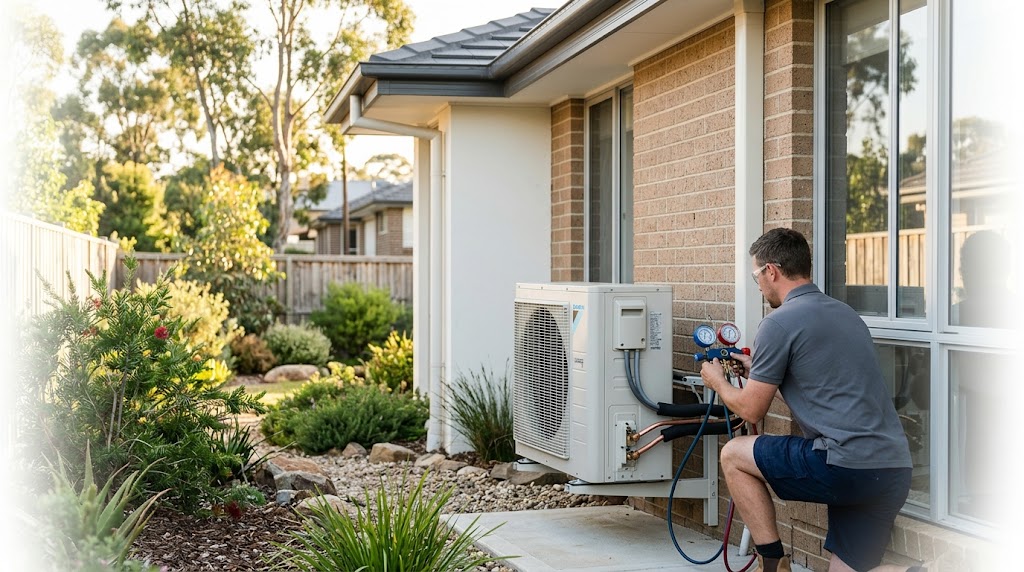
Aircon refrigerant is the chemical compound that makes your air conditioner actually work. Without it, your system is just a fan. Refrigerant is the substance that absorbs heat from inside your home and carries it outside, leaving your rooms cool and comfortable. In reverse-cycle systems, it does the opposite in winter, pulling heat from outdoor air and delivering it inside.
This article covers everything a homeowner needs to know about refrigerant: how it circulates through your system, which types are used in Australian air conditioners today, how to spot the signs of a low charge and what to do if you suspect a problem. Understanding aircon refrigerant will help you make smarter decisions when troubleshooting an underperforming unit or shopping for a new system.
Key takeaways
- Aircon refrigerant absorbs and releases heat to cool or warm your home by changing between liquid and gas states.
- Most new Australian systems use R32, while older units run on R410A or R22.
- Low refrigerant always indicates a leak and requires a licensed technician to repair.
How Aircon Refrigerant Works
Refrigerant is the working fluid that moves heat from one place to another by continuously changing between liquid and gas states. It does not get consumed or burned off in the process. Under normal operating conditions, the same refrigerant charge circulates through your system indefinitely, which is why a drop in cooling performance almost always points to a leak rather than the refrigerant simply running out.
The cycle relies on a basic principle of physics: liquids absorb heat as they evaporate, and gases release heat as they condense back into liquid. Your air conditioner exploits this by controlling the pressure and temperature of the refrigerant at each stage of the loop.
The Four Stages of the Refrigeration Cycle
- Evaporation (indoor unit): Refrigerant enters the indoor unit's evaporator coil as a cold, low-pressure liquid. Warm air from your room passes over the coil, the refrigerant absorbs that heat and evaporates into a gas, and the now-cooled air is blown back into the room.
- Compression: The refrigerant gas travels to the outdoor unit where the compressor squeezes it to a much higher pressure. This compression raises the gas to a high temperature, making it hotter than the outside air so heat can flow outward.
- Condensation (outdoor unit): The hot, high-pressure gas passes through the condenser coil in the outdoor unit. Outside air flows over the coil, the refrigerant releases its heat to the outdoors and condenses back into a warm liquid.
- Expansion: The warm liquid refrigerant passes through an expansion valve, which rapidly drops its pressure and temperature. It arrives back at the indoor evaporator coil as a cold liquid, ready to absorb heat from your room all over again.
In a reverse-cycle system, this entire process can run in reverse during winter. The refrigerant absorbs heat from the outdoor air (even on cold days, there is usable heat energy in air down to around -15 to -20 Celsius) and delivers it inside. This is why reverse-cycle air conditioners are far more efficient than resistive electric heaters.
Types of Aircon Refrigerant Used in Australian Systems
The three refrigerants that matter most to Australian homeowners are R22, R410A and R32. Most split system air conditioners sold in Australia today use R32, but millions of older units still running on R22 or R410A are out there in homes across the country. Knowing which refrigerant your system uses tells you a lot about its age, efficiency and long-term serviceability.
| Refrigerant Type | GWP (Global Warming Potential) | Status in Australia | Typical Systems |
|---|---|---|---|
| R22 | 1,810 | Banned from import since 2020. Cannot be recharged. | Systems installed before approx. 2010 |
| R410A | 2,088 | Still in use. Being phased down under the Kigali Amendment. | Systems installed approx. 2010 to 2020 |
| R32 | 675 | Current standard. Widely available. | Most new split systems sold from 2018 onwards |
R22: The Phased-Out Refrigerant
R22, sometimes called Freon, was the standard refrigerant in Australian air conditioners for decades. Under the Montreal Protocol, Australia banned the import of R22 in 2020, which means any system still running on it cannot legally be recharged with fresh gas. If your unit is more than 15 years old, there is a real chance it uses R22.
A licensed technician can sometimes retrofit an older system to run on an R22 substitute such as R417A, but this is not always straightforward and the performance gains are modest. In most cases, replacing the unit entirely is the more cost-effective path, and you will end up with a far more efficient system in the process.
R410A vs R32: What's in Most Modern Units
R410A dominated the Australian market through the 2010s and is still found in a large number of systems installed before 2018 to 2020. It has a GWP of 2,088, which is high by modern standards, and it is being progressively phased down under the Kigali Amendment to the Montreal Protocol. Systems running on R410A can still be serviced and recharged today, but the refrigerant will become harder to source over time.
R32 has a GWP of 675, roughly one-third that of R410A, and it is now the refrigerant of choice for leading brands including Daikin, Mitsubishi Electric and Fujitsu. Beyond the environmental advantage, R32 also has better thermodynamic properties than R410A, which means the compressor does not have to work as hard to move the same amount of heat. The result is a modest but real improvement in energy efficiency.
Real-world examples of R32 systems available from Air Conditioning Experts include the Daikin split systems Lite and Cora ranges. The Daikin Lite FTXF25WVMA starts at $989 and the Daikin Cora FTXV25WVMA from $1,054, both running on R32. One trade-off worth knowing: R32 is classified as mildly flammable (A2L rating), but in normal residential installations this poses no practical safety concern. Handling and disposal still require a licensed refrigerant technician.
Signs Your Aircon Refrigerant Is Low
A refrigerant-low air conditioner shows five clear warning signs that homeowners can spot without any technical knowledge. Refrigerant does not deplete on its own under normal operation, so a low charge always means there is a leak somewhere in the system. Spotting the symptoms early can prevent a minor leak from turning into a compressor failure.
- Warm air blowing from the indoor unit: If your system is running but the air coming out feels lukewarm or barely cool, the refrigerant charge may be too low to absorb heat effectively from your room. This is one of the most common first signs.
- Ice forming on the coils: Ice on the indoor evaporator coil or on the refrigerant lines running to the outdoor unit is a strong indicator of low refrigerant. Without enough refrigerant, the coil temperature drops too far and moisture in the air freezes on contact.
- Hissing or bubbling sounds: A refrigerant leak often produces a faint hissing noise near the indoor unit or along the refrigerant lines. A bubbling sound can indicate refrigerant and air mixing at the leak point. Either sound warrants a call to a technician.
- Higher-than-usual electricity bills: A system running low on refrigerant has to work much harder and run for longer to reach the set temperature. If your power bills have crept up without any obvious change in usage, a refrigerant issue could be the cause.
- Slow cooling or heating: If your system takes significantly longer than it used to reach the temperature you have set, reduced refrigerant capacity is a likely culprit. The system is still trying to do the same job with less working fluid.
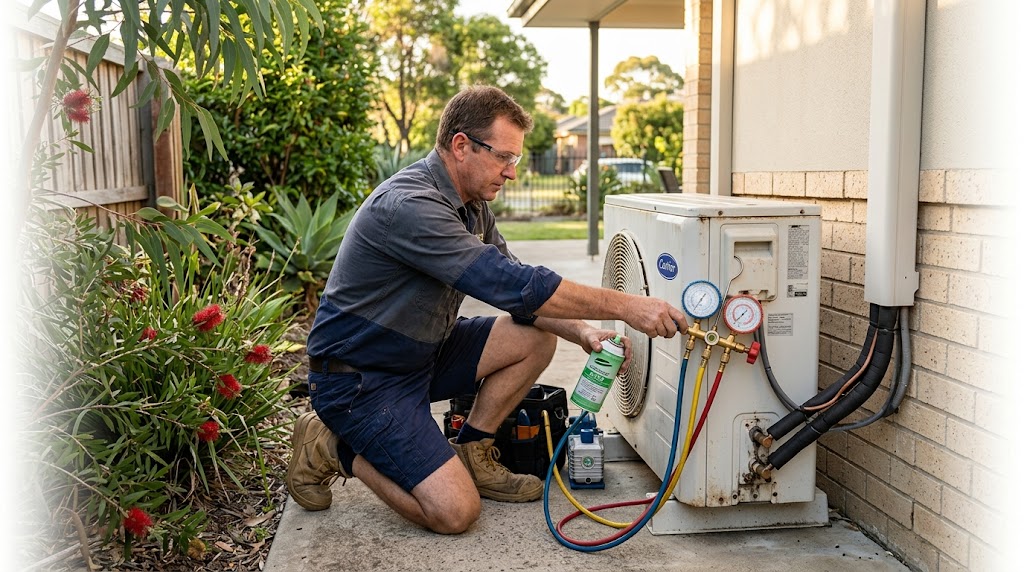
Never attempt to recharge refrigerant yourself. In Australia, handling refrigerants is restricted to licensed refrigerant handling technicians under the Australian Refrigeration Council (ARC) framework. A proper repair involves locating and fixing the leak first, then recharging to the correct specification. Simply topping up without fixing the leak is a waste of money and will not solve the underlying problem.
What to Do If You Suspect a Refrigerant Problem
If your air conditioner is showing signs of low refrigerant, the right move is to turn the system off, stop using it and call a licensed air conditioning technician. In Australia, purchasing, handling and disposing of refrigerant is restricted to technicians who hold an ARCtick licence under the Ozone Protection and Synthetic Greenhouse Gas Management Act. It is illegal for unlicensed individuals to buy or handle refrigerant.
Running a refrigerant-low system for extended periods puts serious strain on the compressor. The compressor relies on refrigerant to carry lubricating oil around the circuit, so operating without a full charge can cause it to overheat and fail. Compressor replacement is expensive, often costing more than the unit itself, so switching the system off as soon as you notice symptoms is the smartest thing you can do.
When you call a technician, ask specifically for a leak test before any recharge is carried out. A reputable technician will locate and repair the leak first. Simply topping up the refrigerant without fixing the source is a short-term fix that will leave you back in the same position within months.
If your system was installed before 2015 and is running on R22, the calculation changes significantly. R22 can no longer be legally imported into Australia, which means recharging an R22 system is not an option. Retrofitting with a substitute refrigerant is possible in some cases but rarely cost-effective. For most homeowners in this situation, replacing the unit with a modern R32 system delivers better cooling performance, lower running costs and a system that can actually be serviced for years to come. You can browse our range of split system air conditioners to see what a modern replacement would cost.
Choosing a New System With the Right Refrigerant
Every new residential split system sold in Australia today uses R32 as its refrigerant. R32 is the current industry standard across all major brands, and it is what you should be looking for if you are buying a replacement unit or upgrading an older system. Some larger commercial systems use R454B, but for home use R32 is the refrigerant you will encounter across the board.
Before purchasing any unit, check the product data plate on the outdoor unit or the spec sheet from the manufacturer. The refrigerant type is always listed there. If a retailer cannot confirm the refrigerant type, that is a red flag worth taking seriously.
For homeowners looking at entry-level options, the Daikin Lite 2.5kW FTXF25WVMA is the most affordable starting point at $989. The Daikin Cora 2.5kW FTXV25WVMA steps up slightly in features and comfort at $1,054, with a quieter indoor unit and a more refined finish. Both run on R32 and are well suited to bedrooms or smaller living spaces up to around 20 to 25 square metres.
For a living room or open-plan area, the Daikin Cora 5kW FTXV50WVMA is one of the most popular mid-size choices on the market, priced from $1,697. It handles larger spaces comfortably, runs on R32 and carries Daikin's reputation for reliability in Australian conditions.
All three are solid choices that will be fully serviceable for the foreseeable future, with refrigerant that is widely available and competitively priced. Explore our Daikin split systems range to find an R32 unit that suits your home.
Frequently Asked Questions About Aircon Refrigerant
What refrigerant do most Australian air conditioners use?
Most new split system air conditioners sold in Australia today use R32 refrigerant. R32 has largely replaced R410A across all major brands including Daikin, Mitsubishi Electric and Fujitsu. If your system was installed before around 2018, it likely runs on R410A or, for older units, R22.
Can I recharge my aircon refrigerant myself?
No. In Australia, purchasing and handling refrigerant is restricted to licensed technicians who hold an ARCtick licence under the Ozone Protection and Synthetic Greenhouse Gas Management Act. It is illegal for unlicensed individuals to buy or handle refrigerant. Always call a qualified air conditioning technician for any refrigerant work.
How do I know if my aircon is low on refrigerant?
The most common signs are warm air blowing from the indoor unit, ice forming on the coils or refrigerant lines, hissing or bubbling sounds near the unit and a noticeable increase in electricity bills. Slow cooling or heating is another reliable indicator. Any of these symptoms warrants a call to a licensed technician.
Is R32 refrigerant safe?
R32 is classified as mildly flammable with an A2L safety rating, but in standard residential installations this poses no practical safety risk. It has been used safely in millions of homes across Australia and globally. All handling, installation and disposal must be carried out by a licensed refrigerant technician regardless.
What happens if I keep running my aircon with low refrigerant?
Running a refrigerant-low system puts serious strain on the compressor, which relies on refrigerant to carry lubricating oil around the circuit. Prolonged operation without a full charge can cause the compressor to overheat and fail. Compressor replacement often costs more than the unit itself, so switching the system off at the first sign of trouble is the right call.
What is the difference between R410A and R32?
R32 has a global warming potential (GWP) of 675, roughly one-third that of R410A at 2,088. R32 also has better thermodynamic properties, meaning the compressor works less hard to move the same amount of heat, which translates to a modest improvement in energy efficiency. R410A is still serviceable today but is being progressively phased down under the Kigali Amendment.
Can an R22 system be recharged in Australia?
No. Australia banned the import of R22 in 2020, so there is no legal supply of fresh R22 gas available for recharging. Some technicians can retrofit an R22 system to run on a substitute refrigerant such as R417A, but this is rarely cost-effective. For most homeowners, replacing the unit with a modern R32 split system is the more practical and economical solution.
Need expert advice?
Our team can help you choose the right air conditioning system for your space.